
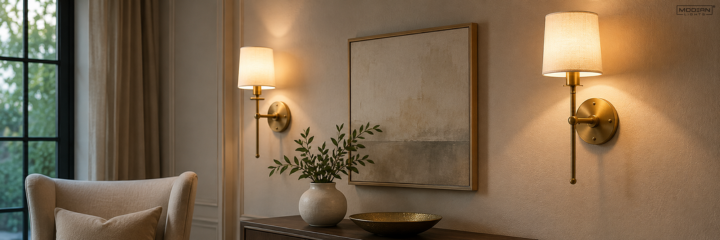
Wall sconces are perhaps more often overlooked than any other fixture in the home. People will spend hours picking out a chandelier and then buy whatever sconce looks “close enough” for the hall. That's where we usually get it wrong - wrong height, wrong finish, wrong light output for the space.
Wall sconces should be placed 60–66 inches off the floor, 8–10 feet apart in hallways (24–36 inches for pairs of mirrors), and paired with a warm 2700K–3000K bulb, approximately 400–800 lumens, for ambient use. Hardwired for permanent installations, plug-in for rentals and retrofits, and a style and finish to match the room’s existing hardware.
A good sconce does more than just fill a blank wall. It creates the atmosphere for a room at night, it fills in shadows that your overhead lighting misses, and it adds a level of depth that a flat ceiling light alone cannot offer. But you need to know a few things up-front to get it right: what type of sconce works for your wiring situation, what style actually works for the room, where it goes, and how big it needs to be.
This guide has it all — types, how to choose a style, placement rules that actually work in real homes, sizing maths, bulb choice and the mistakes that trip up most first-time buyers. By the time you’re done, you'll know precisely what to look for before you add anything to the cart.
What Is a Wall Sconce and Why Use One?
A wall sconce is a light fixture that is attached directly to a wall (not a ceiling). That’s the technical difference between a flush mount or pendant, but the practical difference is more important: sconces sit at eye level, which means they light a room horizontally rather than just from above.
That horizontal light, interior designers call layered lighting. A single overhead fixture provides flat even light, with hard shadows beneath faces and furniture. A few sconces here and there around the room break up that flatness—shadows are less stark, corners no longer look so dead, and the whole space reads warmer. Browse the full Wall Lights Collection to see the range of styles built for this exact purpose.
Sconces also serve a dual purpose depending on their use. Some are ambient, washing a wall with light up or down, to establish a mood. Some are task-oriented, such as a swing-arm sconce next to a reading chair. But before choosing a style you need to know what you want it to do.
Types of Wall Sconces
figure out installation type, before style. While aesthetics are important, this decision often has a bigger impact on your final decision since it helps determine if you can install it yourself or if you need an electrician to do it.
Hardwired Sconces
Hardwired sconces are wired directly into your home’s electrical wiring, using a junction box in the wall. They’re the norm for new builds or full remodels, because the wiring is planned in before the plasterboard goes up. The upside: a clean, permanent install with no visible cord – nothing hanging down the wall, nothing to unplug.
The catch is that retrofitting a hardwired sconce into an existing wall without a junction box typically involves hiring an electrician to run wiring and cut into plasterboard. Think about the price of that before you fall in love with a hardwired-only design unless you’re already planning to do electrical work.


Plug-In Sconces
Plug-in sconces are meant for the situations that hardwired sconces aren't. Existing homes, rentals or anyone who doesn't want to mess with the wiring in their walls. They plug into a standard cord, usually through a cord cover that matches the wall color so it blends instead of dangling loose.
They are far more attractive these days, with plug-ins available for just about every style, including designs that look exactly like their hardwired counterparts once installed. If you are renting or just don’t want an electrician involved, here’s the practical starting point.


Swing-Arm and Adjustable Sconces
Swing-arm sconces are built first for function. It has a pivoting arm that extends so you can place the light exactly where you want it – over a book, on a desk, across a vanity mirror. They are the favorite bedside reading lights when you want to clear some space on the nightstand and are also often found in home offices and workshops for the same reason.
If you don’t want moody, ambient lighting and you actually need to see something clearly, then this is the category you should be shopping.


Wall Sconce Styles by Room and Aesthetic
Once you know your installation type, style narrows down fast based on the rest of the room.
Modern and Minimalist Sconces
This category is characterized by clean lines, simple geometric shapes and finishes such as matte black, brushed nickel, or brass. These sconces are more likely to fade into contemporary spaces than stand out, so they’re a safe bet for open-concept homes or anywhere the existing decor is already busy.
Traditional and Transitional Sconces
Think candle-style arms, glass shades and warmer metal tones such as antique brass or oil-rubbed bronze. They work well in entryways, dining rooms and staircases where a touch of formality is right for the space. Transitional versions lose some of the ornate detail but keep the warmth, so these are a happy medium between traditional and modern.
Industrial and Farmhouse Sconces
You’ll see exposed bulbs, cage designs and black iron finishes. The style has a raw, utilitarian look that works well in kitchens, mudrooms and converted spaces. It’s also one of the more forgiving categories for mixing metals with other fixtures already in the room, as the aesthetic calls for a bit of imperfection.
Where to Install Wall Sconces
Placement is where most of the actual value gets lost or gained. A sconce in the wrong spot looks like an afterthought no matter how nice it is.
Hallways and Staircases
Sconces are perfect for long, narrow spaces where floor lamps or table lighting are usually out of the question. Space them evenly along the wall, approximately 8 to 10 feet apart depending on the length of the hallway, to ensure the light is spread evenly and doesn’t create dark gaps.


Bedrooms
Bedside sconces are among the category’s most common applications, primarily because they clear up nightstand clutter. Mount them approximately 24 to 30 inches above the mattress, in the middle where you’d normally place a nightstand lamp, so the light shines where you’d actually be reading. Explore the full Bedroom Lighting Collection for coordinated sconce and lamp pairings.


Bathrooms
Vanity sconces are placed on either side of the mirror at eye level, generally 60 to 66 inches from the floor. If you have two sconces, space them 24-36 inches apart (depending on the width of the mirror) so the light falls evenly over the face and doesn't cast a shadow on one side. See matching options in the Bathroom Lighting Collection.


How to Size and Space Wall Sconces Correctly
Sizing mistakes are the most common reason a sconce ends up looking wrong on the wall, even in the right room.
| Placement | Mounting Height | Spacing |
|---|---|---|
| Hallways / staircases | 60–66 in. | 8–10 ft. apart |
| Bedside | 24–30 in. above mattress | Centered per side |
| Bathroom vanity pairs | 60–66 in. | 24–36 in. apart |
Fixture width matters relative to the wall space, too. A sconce that's too small on a large blank wall looks lost; oversized on a narrow wall looks cramped. As a starting point, the fixture should take up no more than a third of the visible wall space it's mounted on.
Choosing the Right Bulb and Light Output
Sconces are usually secondary lighting, so they don't need to carry a whole room on their own — but the wrong bulb can still throw off the mood entirely.
For ambient sconces, aim for 400 to 800 lumens per fixture, with a warm color temperature of 2700K to 3000K, which has a cozy, not clinical feel. For example, task-oriented sconces, such as reading lights, can be brighter (up to 1,100 lumens) because they are designed to light a particular area rather than the entire room. Confused by what you read on a bulb box?our Lumens vs. Watts guide breaks it down room by room.
Dimmable sconces are worth the small price difference in almost every case. They let the same fixture work for both bright, functional light and low, ambient light depending on the time of day, without needing a second fixture for either job.
Wall Sconces vs. Other Wall Lighting Options
Sconces aren't the only wall-mounted option, and it's worth knowing where they fit against the alternatives.
Flush mounts sit closer to the wall and cast a more directional, focused light, making them better suited for task areas than mood lighting. Picture lights are narrower in width, and they are intended to illuminate artwork rather than light a room. LED strip lighting gives a more diffused, modern glow but lacks the architectural presence a sconce brings to a wall. If you want a dual-purpose fixture that’s both a light source and decor, sconces are the more powerful choice of the three generally. See our Pendant Lights vs. Chandeliers guide for more on how sconces work with a complete layered plan including ceiling fixtures.
InfoGraphics

Common Wall Sconce Buying Mistakes
- Mounting too high or too low. Straying far from the 60–66 inch range throws off the whole room's balance.
- Mismatched finish. Mixing a brand-new brushed nickel sconce with oil-rubbed bronze cabinet hardware creates visual friction rather than contrast.
- Ignoring IC rating. If the sconce is going into an insulated wall or ceiling area, it needs an IC (insulation contact) rating to avoid a fire hazard.
- Skipping dimmer compatibility. Not all sconces, especially LED-integrated ones, work with standard dimmers — check before assuming.
- Underestimating spacing. Placing multiple sconces too close together on a long wall creates uneven, patchy light instead of a smooth wash.
FAQs
How high should wall sconces be mounted?
Most wall sconces should be mounted between 60 and 66 inches from the floor to the center of the fixture, which lines up with average eye level.
Do wall sconces need to be hardwired?
No. Plug-in sconces are a fully functional alternative that use a standard outlet and cord cover, making them a good fit for rentals or homes without existing wiring in the wall.
Can wall sconces be used as the only light source in a room?
They can in small spaces like hallways or powder rooms, but in larger rooms they work best paired with overhead or ambient lighting rather than standing alone.
How far apart should wall sconces be spaced?
For hallways and long walls, 8 to 10 feet apart is standard. For pairs flanking a mirror or headboard, 24 to 36 inches apart works better.
Are wall sconces still in style in 2026?
Yes — if anything, they've grown more popular as layered lighting design has become standard practice in both new builds and renovations.
Conclusion
Getting a wall sconce right comes down to a handful of decisions: hardwired or plug-in, the style that fits the room, correct height and spacing, and a bulb that matches the mood you're going for. Skip any one of those steps and even a beautiful fixture can end up looking like it doesn't belong.
Once you've got those basics locked in, picking the actual design becomes the easy part. Browse our full Wall Sconces Collection to find a style that fits your space, or reach out if you want help narrowing it down.
Share:
What Is CRI in Lighting? Why It Matters More Than You Think?
7 Best Ceiling Lights for Bedrooms in 2026