
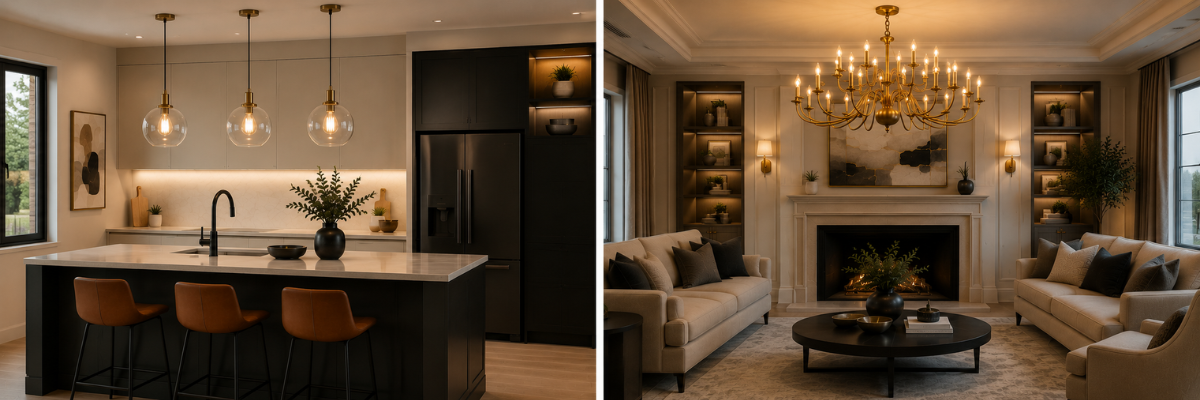
Both hang from the ceiling. All it takes to make a room utterly different. Then why is choosing between a pendant light and a chandelier more challenging than it should be? The glaring truth: most advice on the Internet treats them as interchangeable, which they are anything but. But the difference is not only skin-deep — it's function, ceiling height, proportion, and how you WORK in the space. Well, this article simply answers that question in a no-nonsense, room-by-room manner.
What Is a Pendant Light?

A pendant light is simply a light fixture that hangs from the ceiling by either a cord, chain, or rod. It produces a narrow, concentrated beam of light, so it is great for task lighting but not as effective in lighting up an entire room. Popular designs include mini pendants (tight across a counter or desk), globe pendants, drum pendants, and linear multi-pendant bars covering longer countertop surfaces — like kitchen islands. For the most part, they adjust to your height so you can work over the work surface, which is a bigger deal than people might think.


What Is a Chandelier?

A chandelier is a multi-arm or branched fixture with one or more light sources — it casts the light outward and upward as well as downward, so it is an ambient light and not a task lighting unit. It is aesthetic by nature; in most rooms, the chandelier is your eye's first stop when you enter a space—styles span traditional crystal and tiered silhouettes to modern sputniks, drum chandeliers, and simple linear chandeliers. It has more wires and is heavier than a pendant, and ceiling height matters much more.


Pendant Light vs Chandelier: Key Differences at a Glance
| Feature | Pendant Light | Chandelier |
|---|---|---|
| Light sources | Single bulb (or a few in multi-pendant bars) | Multiple arms / bulbs |
| Light direction | Focused downward | Ambient — outward and upward |
| Primary function | Task & accent lighting | Ambient & decorative lighting |
| Ideal room size | Any — scales with number of pendants | Medium to large rooms |
| Minimum ceiling height | 7.5 ft | 8 ft (9 ft+ preferred) |
| Typical price range | $50 – $400 | $150 – $2,000+ |
| Installation complexity | Low — lighter, simpler wiring | Medium to high — heavier, fan-rated box often needed |
| Best use case | Kitchen island, bedside, reading nook, casual dining | Formal dining, foyer, living room centrepiece |
In short: pendants are workers, chandeliers are showpieces. You can use either as your main ceiling fixture, but they don't do the same job — and that distinction should drive your decision.
How to Choose Between a Pendant Light and a Chandelier
Ceiling Height: The First Thing to Check
Measure your ceiling before you get attached to a fixture online. This one step eliminates half of the options immediately.
- For chandeliers: at least 8 ft clearance, 9 ft and above are really comfortable. A chandelier should hang no lower than 7 ft from the floor in a living or dining space. 30–36 inches above the surface — close enough to feel like we're sharing a moment; far enough back that nobody's staring into a bulb.
- For pendant lights: you can have 7.5 ft ceilings and be okay! For higher-mounted TVs, like over a counter or island, target 30–36 inches above the worktop. 28–34 inches works over a round tabletop, depending on the shape and size
- Low ceilings (below 7.5 ft): skip both and explore flush-mount or semi-flush lights, too. The first of many common lighting mistakes that we see is trying to cram a chandelier into a low-ceiling room.
Room Size and Fixture Scale
More than anywhere else, scale is where people misfire. If it is too small, the fixture just disappears. Too much, it just takes over the room.
A singular statement pendant, perhaps even a petite chandelier, does really well in smaller rooms. You can introduce large open areas with a grouping or a chandelier that has presence
Lighting Function: Ambient vs Task
A chandelier lights a room. A pendant lights a spot. Neither is superior — they fulfill different requirements
- Chandeliers: Nobody will spend a second more than necessary settling into place; chandeliers will dance dew-light about the place. They're what you reach for when the room needs to be warm, cozy, and inviting — dinner parties, a first impression, a living room where people gather.
- Pendants are precise. Over a kitchen island where you're chopping, over a reading chair, above a desk — pendants put the light exactly where the work is happening.
- When you need both: layer them. A chandelier as the main source, pendants or lamps for task work. This is how most well-lit rooms are actually built.
Design Style and Room Aesthetic
There are no hard-and-fast rules in this regard, but certainly reliable trends. Chandeliers are at home in formal dining rooms, grand entryways, traditional decor,r and basically anywhere a focal piece is needed above the furniture. Pendants belong in modern kitchens, pared-back bedrooms, lofts with an industrial edge, and Scandi-tinged spaces,while they make casual dining areas really shine.
That being said, there is a gray area that the magazines seldom speak of. A sputnik chandelier fits in perfectly well with a modern living room. Even a strip of a lit oversized drum pendant over a dining table can appear more intentional than any chandelier. Lean on the ratios and not the label of the sub-category
Budget and Installation
- Pendant lights typically run $50–$400. They're also lighter, the wiring is much simpler, and most competent DIYers can tackle the installation.
- Chandeliers range from $150 to more than $2000 for a statement piece. As we tend to be a bit more aware of the fixtures' weight, be sure that your ceiling junction box is fan-rated (light fixture displays weight capacity, rated for over 50 lb. For anything too heavy or complicated is worth calling in an electrician — it's a one-off cost less than fixing the ceiling.
Which Fixture Works Best in Each Room?

Dining Room
If you have a formal dining room and are working with a round or square table, ceiling height over 8.5 ft? Then trust us, chandeliers are the way to go! Make it half to two-thirds the width of your table and have it hung 30-34 inches above the top of the table. For a dining space that is informal, use one long rectangular table or, if the ceiling is down 88 ft, two or three pendants in a row, because they do the same job with less visual weight and are much easier to install
→ See our full dining room lighting guide for layout diagrams and examples.
Kitchen Island
Here, pendants win— period. You use this island as a workspace; it's not ambient glow from above; you need directed light at counter level. Two pendants: for islands shorter than 5 ft long. Three pendants: anything from 6–8 ft Space evenly, centred over the island, and a height of 30–36 inches above the countertop. A mini chandelier over a small round kitchen table, sure, but under the prep space?
→ Shop pendant lights to find the right size for your island.
Entryway and Foyer
Chandeliers have their rightful place in two-storey foyers and entries with ceilings greater than 10 ft. They occupy vertical airspace like nothing else, and their presence determines the mood of the home beginning the moment a visitor crosses the threshold—tiered or branched designs especially shine in tall entries. For a standard 9–10 ft ceiling in a modern entryway, one big chandelier is cleaner and easier to manage proportionally.
→ More ideas in our entryway lighting guide.
Living Room
Layered lighting is most important in the living room because you use that space for so many purposes — watching TV, reading, hosting people to hang out, or just relaxing. If you have a ceiling space of 9 ft or above,e then definitely a chandelier makes for a great focal point over the seating arrangement. Combine that with floor lamps and table lamps, ensuring you are not just dependent on the ceiling light sources only. Accessible for spaces with lower hanglines, pendants as accent lighting — above a reading chair or side table — give warmth and hospitality without the full commitment of a chandelier
→ Browse our lamps collection to build out the layers.
Bedroom
You get serious illumination, a long-wanted task light at your bedside + you free up surface space because you no longer need lamps on the nightstands, and drop-in pendant lights give the room an intentional look. Place them 18–24 inches above the height of the mattress. In a generously sized master bedroom, a wee chandelier or an ample drum pendant as the centerpiece creates an air of occasion without the direct overhead glare of a recessed fixture
Can You Use Pendant Lights and a Chandelier in the Same Space?
Yes — and it can actually be the most intelligent option in open-plan homes. Naturally, a chandelier above the dining area and two pendants over the kitchen island in that same open area.
When mixing, keep these three things consistent:
- Metal finishes: Use matching finishes, or at least ensure the two are in the same finish family ( for example -- brushed brass and polished gold might work, but matte black and chrome won't).
- Colour temperature: stick to warm white throughout — 2700K to 3000K. Mixing cool and warm light in the same open space looks disjointed and unflattering.
- Scale contrast: vary the scale intentionally. A big chandelier combined with smaller pendants feels intentional. Two fixtures pleading for your attention, with the same lead-in and reads as an accident.
→ More on this in our 2700K vs 5000K colour temperature guide.
Pendant Light vs Chandelier: Quick Decision Guide
| Your situation | Go with a Pendant | Go with a Chandelier |
|---|---|---|
| Ceiling height | 7.5 ft – 8.5 ft | 9 ft and above |
| Room size | Small to medium rooms; or large rooms with multiple pendants | Medium to large rooms needing a focal point |
| Primary need | Task lighting over a surface | Ambient light to fill the room |
| Room style | Modern, minimalist, industrial, Scandi, casual | Traditional, formal, maximalist, grand entryways |
| Budget | Under $300 | $300 and above for quality |
| DIY install | Yes — lightweight, simple wiring | Maybe — verify junction box rating first |
| Space type | Kitchen, bedroom, reading nook, casual dining | Formal dining, foyer, living room centrepiece |
Neither fixture is universally the right answer. The right answer is room-specific — and now you have the information to make it confidently.
Frequently Asked Questions
Q1. What is the difference between a pendant light and a chandelier?
A pendant light is a single fixture suspended from the ceiling that directs light downward — best for task lighting. A chandelier has multiple arms or light sources and spreads ambient light across a room. Pendants are functional; chandeliers are decorative as well as functional.
Q2. Is a chandelier or pendant better for a dining room?
For a formal dining room with ceilings above 8.5 ft, a chandelier is the better choice — it creates presence above a round or square table. For casual dining, long rectangular tables, or lower ceilings, two or three pendants in a row are a more practical and equally stylish option.
Q3. What ceiling height do you need for a chandelier?
At minimum 8 feet, though 9 feet or more gives you proper clearance and better proportions. The bottom of the chandelier should sit no lower than 7 ft from the floor in a living area, and 30–36 inches above a table surface in a dining room.
Q4. How many pendant lights do I need over a kitchen island?
Two pendants for islands under 5 ft long, and three for islands between 6–8 ft. Space them 24–30 inches apart, centred over the island, and hang them 30–36 inches above the countertop surface.
Q5. Can you use a chandelier in a small room?
Yes — if you size it correctly. Use the room-dimension formula: add the room's length and width in feet, and that number in inches is your target chandelier diameter. A 10 × 10 ft room calls for roughly a 20-inch chandelier. Mini chandeliers are designed specifically for smaller spaces.
Q6. Are pendant lights cheaper than chandeliers?
Generally yes — pendants typically run $50–$400, while chandeliers start around $150 and go well beyond $2,000 for quality statement pieces. That said, there's real overlap: a designer pendant can cost more than an entry-level chandelier. Budget isn't the only factor to weigh.
Q7. Can you mix pendant lights and a chandelier in the same room?
Yes — it's common in open-plan layouts where a chandelier anchors the dining zone and pendants light the kitchen island. To make it work, match your metal finishes, keep the colour temperature consistent (2700K–3000K warm white throughout), and vary the scale intentionally so the fixtures complement rather than compete.
Ready to choose? Browse both collections and find the right fit for your space.
Shop Chandeliers Shop Pendant Lights
Share:
Why Every Modern Home Needs a Statement Chandelier?
How to Buy Lighting Fixtures Online Without Regret?