
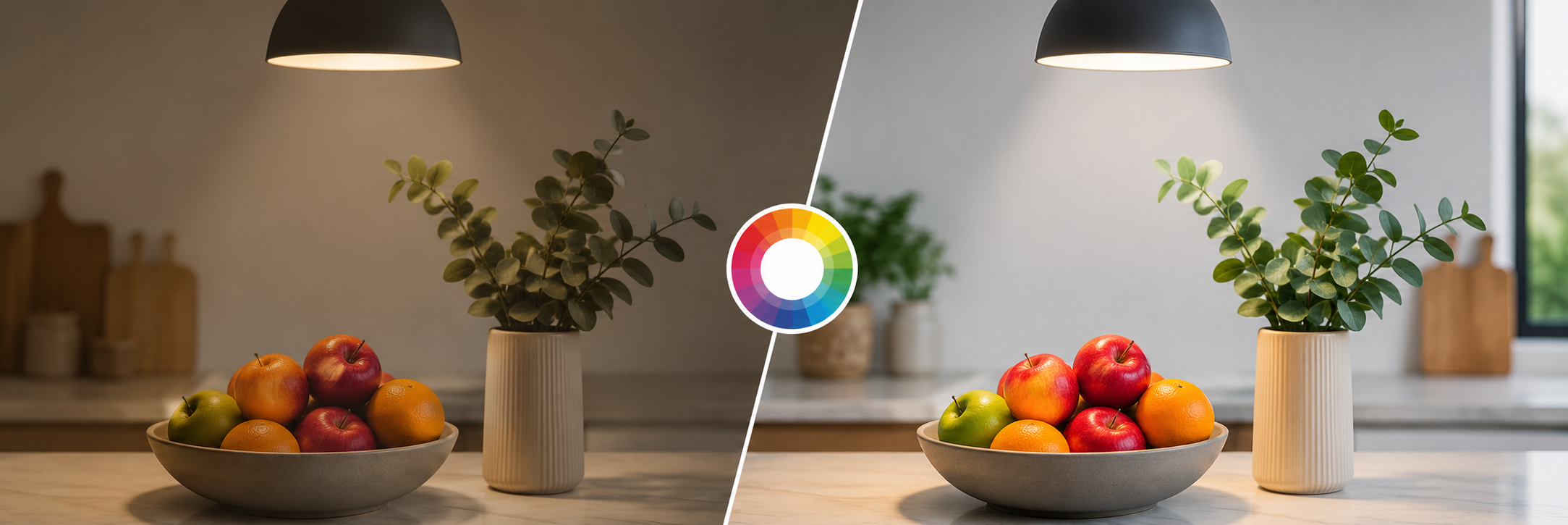
Have you ever bought a blouse in the store that was navy blue and then took it home and found out it was black? Or picked a paint color that seemed warm and inviting under showroom lights, only to have it look flat and drab in your living room? That’s CRI in action, or rather inaction.
CRI, or the Color Rendering Index, is one of the most underappreciated criteria when shopping for light bulbs and fixtures. Most purchasers focus on brightness (lumens) or warmth (color temperature) and ignore CRI altogether; however, CRI determines how realistic colors look under a light source. A really bright low CRI light will make food look unappetizing, make furniture look drab, and wipe out skin tones.
To help you purchase smarter, this article will explain what CRI really means, how it's assessed, what a good rating looks like, and where it matters most.
CRI (Color Rendering Index) is the ability of a light source to portray the true colors of an object as compared to natural light. The scale is from 0 to 100. A CRI of 90 or more is considered high and is ideal for locations such as kitchens, baths, and closets where accurate color is important. CRI is not lumens (brightness). A bulb might be bright yet still be bad at rendering colors if it has a low CRI.
What Does CRI Mean?
CRI is short for Color Rendering Index, which tells how correctly a light source displays colors against natural daylight. It's scored on a scale from 0 to 100. The greater the number, the more the colors will look like they would look in the sun.
Natural daylight is the standard with a perfect 100. All artificial light sources—LED, incandescent, and fluorescent—are rated against those criteria. A bulb with a 95 CRI renders colors almost as well as daylight. A CRI 60 bulb will clearly distort some hues, yet the room will still look “bright enough.”
That’s why two bulbs that have the same brightness and color temperature may make a room seem radically different. CRI is the missing variable that most people don't know to check.
How Is CRI Measured?
CRI testing requires a light source to be shone on eight standard color samples (designated R1 to R8)—a combination of muted tones such as soft green, dusty blue, and light skin tone. Each sample is compared in the test light with its appearance in normal daylight. The CRI score is the average difference among all 8 samples.
This isn’t just a lab exercise—this is why two “warm white” bulbs from different brands can seem radically different in your kitchen. One can show your countertop's true color; the other might make it a little yellow or gray.
The R9 Problem
Standard CRI testing does not test for R9, a measure of saturated red. Most light bulb packaging will not inform you of this. This is more important than it sounds—red is one of the hardest colors for light sources to get right, and it's everywhere: skin tones, wood furniture, brick, red cloth, and food.
CRI Scale Explained: What's a "Good" Rating?
Not all CRI scores are created equal, and "high enough" depends on where the light is going:
| CRI Range | Rating | Best For |
|---|---|---|
| Below 80 | Poor | Avoid for most living spaces |
| 80–89 | Acceptable | General lighting, hallways, garages |
| 90–95 | High CRI | Kitchens, bathrooms, retail, living rooms |
| 95–100 | Premium | Art studios, photography, color-critical work |
For most homeowners, 90+ CRI is the sweet spot — accurate enough for everyday color-sensitive tasks without paying a premium for lab-grade precision you won't notice.
CRI Ratings by Common Light Source
Quick reference for what you're typically getting:
- Incandescent bulbs: ~100 CRI (naturally excellent, but inefficient)
- Standard LED bulbs: 70–80 CRI (fine for basic use, weak for color accuracy)
- High-CRI LED bulbs: 90–98 CRI (built specifically for color-sensitive spaces)
- Fluorescent tubes: 60–85 CRI (varies widely, often on the lower end)
LEDs get a bad reputation for "flat" light, but that's usually a low-CRI LED problem, not an LED problem. High-CRI LEDs solve this while still keeping the energy efficiency.
CRI vs. Lumens: Different Things Entirely
This is the kind of thing we constantly see: people think a more powerful bulb will make the colors look better. No, it won't. Lumens quantify the amount of light a bulb gives out. CRI evaluates how well that light reproduces color. These are different standards, and a bulb can shine in one but fail in the other.
A 1,600-lumen bulb with a CRI of 70 will do a wonderful job lighting up a room, but colors under it will appear a little wrong—muted reds, grayish whites, and poor skin tones. A 1,600-lumen bulb with a CRI of 95 will appear just as bright, but everything under it will look lifelike.
Where High CRI Actually Matters
High CRI isn't necessary everywhere, but in certain rooms it makes a real difference:
- Kitchens — food looks fresher and more appetizing under accurate light
- Bathrooms/vanities — makeup, skin tone, and grooming rely on true color
- Closets — matching an outfit means seeing its actual colors
- Retail and product displays — merchandise needs to look like it does in daylight
- Art studios and photography — color accuracy isn't optional, it's the job
Spaces where standard CRI is perfectly fine: hallways, garages, storage areas, utility rooms — anywhere color accuracy isn't part of the task happening there.
InfoGraphics

How to Check CRI Before You Buy
CRI is usually listed on the packaging or product spec sheet, often labeled "CRI" or "Ra" (color rendering average). If a listing doesn't mention CRI at all, that's worth treating as a red flag — it usually means the rating is low enough that the manufacturer would rather not advertise it.
A simple buying rule: for any space where color matters — kitchens, bathrooms, living rooms — look for CRI 90 or higher. For utility spaces, 80 CRI is fine and you'll save money without noticing a difference.
Looking for fixtures and bulbs built around true color accuracy?
Shop High CRI Ceiling Lighting →FAQ
Conclusion
CRI isn't about how bright a light is — it's about how truthfully it shows color. A high-lumen bulb with a low CRI will still make your kitchen, closet, or living room look slightly off, even if the room feels well-lit. The simple rule: for any space where color matters, look for CRI 90 or higher, and don't assume a bulb is high-CRI just because it's a good LED. Check the spec sheet, not just the brightness number.
Share:
Lumens vs. Watts: How Much Light Does a Room Actually Need
Wall Sconces: The Complete Buying Guide