
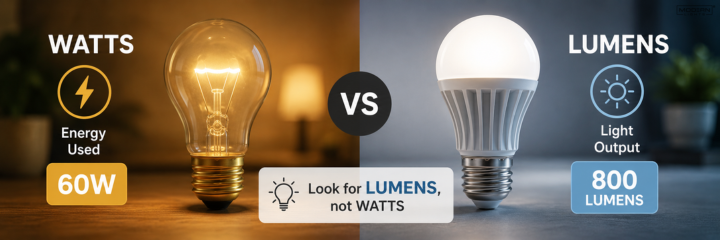
Watts tell you how much energy a bulb needs, not how bright it is. Lumens are the measure of actual light production. When choosing bulbs, look at the lumens number on the box, not the watts – a 9-watt LED can make more light than a 60-watt incandescent ever could.
Old habits die hard, and one of them is buying light bulbs by wattage. For decades, watts and brightness were the same because incandescent bulbs were inefficient: more energy in meant more light out, so a 60-watt bulb was always brighter than a 40-watt one. LEDs break that link entirely. Today, a bulb uses a fraction of the energy but still lights up a room better than the incandescent bulb it replaced.
That’s where lumens come in. And lumens measure how much visible light the bulb really generates, not how much electricity it uses. If you’re still buying light bulbs based on wattage, you’re using information that became useless the moment LEDs took over. In this article, we’ll explain the real difference, how to translate your previous wattage habits into lumens, and just how many lumens each area in your home needs.
Lumens vs. Watts at a Glance
| Watts | Lumens | |
|---|---|---|
| What it measures | Energy consumed | Light output (brightness) |
| Tells you | Running cost | How bright the bulb actually is |
| Matters for | Electricity bills | Choosing the right bulb for a room |
| LED era relevance | Secondary | Primary — check this first |
What's the Actual Difference Between Lumens and Watts
- Lumens
- The total amount of visible light a bulb emits.
- Watts
- The amount of electrical energy a bulb consumes to produce that light.
They moved together because incandescent bulbs were so poor at converting energy into light that wattage was a decent proxy for brightness. A 100-watt incandescent bulb outputs something like 1600 lumens or so. Everybody just recalled that amount by its wattage, not its actual output.
LEDs changed the calculus dramatically. A contemporary LED will produce that same 1,600 lumens at about 15 watts. The wattage figure tells you absolutely nothing regarding brightness now; it tells you simply how good the bulb is at turning electricity into light.
How to Convert Watts to Lumens (Old Bulb to LED)
If you're used to shopping by incandescent wattage, here's the rough lumens equivalent to look for on an LED box:
| Old Incandescent | Lumens to Look For |
|---|---|
| 40W | ~450 lumens |
| 60W | ~800 lumens |
| 75W | ~1,100 lumens |
| 100W | ~1,600 lumens |
What matters here is the ratio of efficacy, the number of lumens generated per watt spent (lm/W). A standard basic LED will provide 80-100 lm/W compared to 10-17 lm/W for an incandescent. The ENERGY STAR program demands an unambiguous listing of lumens on the Lighting Facts label on every bulb package, front and center—that's the figure to look at, not the watts line below it.
How Many Lumens Is a 60-Watt Bulb?
A standard 60-watt incandescent bulb generates around 800 lumens. If you’re replacing an incandescent, search for an LED that says “60W equivalent” or that says 750-850 lumens on the box. The LED itself will be much lower wattage, probably 8-12 watts, as it's generating that same light output far more effectively.
Why Two Bulbs with the Same Wattage Can Look Different
All LED’s are not the same. A 9-watt bulb from one manufacturer might yield 700 lumens, while a 9-watt bulb from another brand produces 900 lumens at the same price. The difference is in the efficacy rating,which depends on chip quality and manufacturing. So, two “9W” lights sitting side by side on a shelf may light a space to very different degrees — wattage equivalence does not mean brightness equivalence.
How Many Lumens You Need Per Room
Brightness needs vary by room function. These figures represent total light output across all fixtures in the space combined, not a single bulb.
| Room | Recommended Lumens |
|---|---|
| Living Room | 1,500–3,000 |
| Kitchen | 3,000–4,000 |
| Bedroom | 1,000–2,000 |
| Bathroom | 2,000–3,000 |
| Home Office | 3,000–6,000 |
| Dining Room | 2,000–4,000 |
Kitchens and home offices are at the higher end, as they require task illumination for intensive work. Bedrooms require less overall output, since you don’t want to be as bright as possible, but calm and ambient. If you're considering a living room chandeliers, after you know your goal lumens, a nice next step is to browse living room chandeliers or lamps to round out the ambient layer.
Adjusting for Ceiling Height and Room Size
The standard lumens chart assumes an 8-foot ceiling and average wall color. Ceilings higher than 9 feet need about 20% more lumens to make up for the light loss across the additional distance. Dark paint colors absorb more light than they reflect; therefore, rooms painted dark need more lumens than rooms with pale, reflecting walls.
Quick Formula
Room square footage × foot-candles needed (10–20 for most living spaces) = target lumen output.
Common Mistakes When Buying Bulbs by Wattage Instead of Lumens
Avoid These Mistakes
- Buying a bulb labeled "60W equivalent" without checking the actual lumens number — equivalency claims vary by brand
- Assuming a higher-wattage LED is automatically brighter, which isn't a safe assumption post-LED
- Ignoring color temperature (Kelvin) — the same lumen output can feel dimmer or harsher depending on warm vs. cool tone
- Mixing bulbs with different lumen outputs in the same fixture, creating uneven light
InfoGraphics

FAQ
What's the difference between lumens and watts when buying a light bulb?
Watts tell you how much energy the bulb uses. Lumens tell you how bright it actually is. For LED shopping, lumens is the number that matters — wattage only indicates efficiency now, not brightness.
How many lumens is a 60-watt bulb?
A 60-watt incandescent bulb produces about 800 lumens. Look for that same lumen output on LED packaging if you're replacing one.
Is a bulb with more lumens always brighter?
Yes, more lumens always means more light output, regardless of wattage or bulb type. It's the one number you can compare directly across brands and technologies.
How many lumens do I need to light a living room?
Most living rooms need 1,500 to 3,000 lumens total across all fixtures combined, depending on room size and how much natural light it gets during the day.
What's a good lumens-to-watt ratio for an energy-efficient LED?
Look for at least 80 lumens per watt. Higher-quality LEDs can reach 100+ lm/W, meaning more light for less electricity.
What's the difference between lumens and Kelvin?
Lumens measure brightness. Kelvin measures color temperature — whether the light looks warm and yellow (2700K) or cool and blue-white (5000K+). You need both numbers to pick the right bulb.
How many lumens counts as daylight-bright?
Daylight-equivalent lighting typically falls between 5,000K and 6,500K in color temperature paired with higher lumen output, generally 4,000+ lumens for a full room, similar to what you'd find in a well-lit retail space.
Conclusion
Watts tells you how much it costs to run a bulb. Lumens tell you what it truly looks like once it’s on, and that number should be the one that drives every buying decision now that LEDs have made watts a poor proxy for brightness. Check the lumens on the box against your room’s demands on the chart above, and you’ll never have to wonder how bright a bulb will actually be before you bring it home.
Shopping for a fixture and want the brightness right the first time?
Shop ChandeliersYou Might Also Like
- Table Lamps — add targeted task lighting without overloading a room's total lumens
-
Floor Lamps & Ambient Lighting — fill out the lower layer of a room's lighting plan
Share:
How to Clean a Crystal Chandelier Without Damaging It?
What Is CRI in Lighting? Why It Matters More Than You Think?