
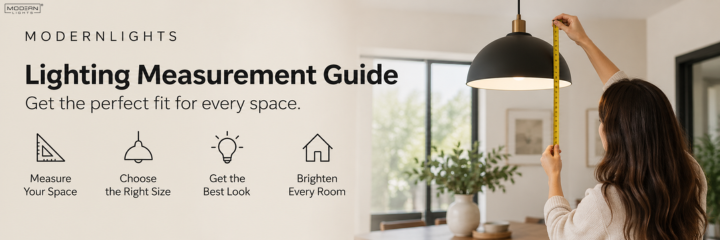
It’s not just style in terms of choosing a light fixture or ceiling fan. The fixture must fit the space, furniture, ceiling height, and area in which it will be installed. Comparing products is easier if you take a few accurate measurements before shopping for a light that feels properly proportioned once installed.
Before buying lighting, measure the area the fixture relates to most closely. For a vanity light, measure the mirror and vanity. For a pendant light, measure the kitchen island or dining table. For a ceiling fan, measure ceiling height. For a wall sconce, measure the planned mounting height and available wall space.
| Fixture | Measure First | Also Check |
|---|---|---|
| Vanity light | Mirror width | Vanity width and wall space |
| Pendant light | Table or island dimensions | Fixture size and hanging height |
| Ceiling fan | Ceiling height | Blade span and installed height |
| Wall sconce | Mounting height | Width, height, and projection |
| Sloped-ceiling fixture | Ceiling height and angle | Mounting compatibility |
1. Measure for a Vanity Light
Measure the mirror width, vanity width, available wall space, and fixture width. You can compare measurements to choose a vanity light that looks right for the bathroom, rather than just trusting the product photos.
Begin by measuring the mirror from one edge to the other. Then measure the vanity underneath and the usable wall space around the mirror. This is especially true if the mirror is close to cabinets, shelving, side walls, medicine cabinets or other bathroom features.
What to Measure Before Ordering a Vanity Light
- Mirror width
- Vanity width
- Available wall width
- Fixture width
- Fixture height
- Fixture projection
- Junction box position
- Nearby cabinets or shelving
A vanity light doesn't need to be wider than the mirror. There is no single sizing rule that applies to all bathrooms. Instead, think of the relationship of the fixture, mirror, vanity and the surrounding wall space.
A large fixture can overwhelm a small mirror visually, while a narrow fixture may seem too small above a wide vanity. If you have a double vanity, you’ll also want to decide whether you’ll use one long fixture or separate lights above each mirror.
If you’re going to use a 24-inch vanity fixture, mark about 24 inches on the wall with removable tape. Comparing that physical span to your mirror and vanity can make judging fixture scale easier before ordering.
Vanity Lights to Compare
Compare these fixture dimensions with your mirror width, vanity width, and available wall space.


2. Measure for a Pendant Light
Measure the width and length of the kitchen island or dining table under the pendant. Then compare those measurements to the fixture’s length, width, ceiling height, and planned hanging height.
For pendant lighting, the furniture immediately below the fixture is usually a more helpful sizing reference than the entire room. The pendant should visually relate to the kitchen island or dining table, but not overwhelm it.
What to Measure for an Island or Dining Table
- Island or table length
- Island or table width
- Fixture length
- Fixture width
- Fixture height
- Ceiling height
- Suspension length
- Planned hanging height
For a kitchen island, compare the size of the fixture to the size of the island and take into account how much visual space will be left around it when you choose a pendant. A too-large fixture can dwarf a smaller surface, and a very small fixture can look out of place on a longer island.
The same principle applies over a dinner table. Not only the size of the room; think about the size of the table itself. If you’re installing several individual pendants, measure the entire island or table first so you have a clear guide for the spacing.
The result is also affected by the hanging height. Ceiling height. Fixture height. Suspension length. Furniture height and manufacturer's installation instructions.
Before ordering, measure approximately how wide you want the pendant to be across your island or dining table. This makes it easier to judge if the fixture is in proportion to the surface underneath.
Pendant Lights to Compare
Compare these pendant sizes with your kitchen island, dining table, ceiling height, and planned suspension.


3. Measure for a Ceiling Fan
Measure from the finished floor to the ceiling at the proposed installation location (vertically). Then check the blade span, installed height, room sizes, mounting configuration, and downrod compatibility requirements for the fan.
Ceiling fan sizing depends on both horizontal and vertical measurements. Room measurements will help you gauge the scale of the fan, while ceiling height will help you determine how the fan will sit in the room.
Blade Span, Ceiling Height, and Installed Height
- Floor-to-ceiling height
- Fan blade span
- Overall installed height
- Room dimensions
- Mounting configuration
- Compatible downrod options
- Ceiling type
Blade span is the horizontal diameter of the fan from side to side. Installed Height: The distance from the ceiling to the bottom of the fan when installed.
These measurements answer different questions. A fan may have the right blade span for the room but need a different mounting configuration based on the height of the ceiling.
Also check compatible downrods, ceiling angle, and mounting hardware for high or vaulted ceilings. Installation requirements vary by model, so always check the product specifications for the item you are ordering.
A fan with a blade span of 52 inches is a 52-inch fan. On the horizontal is its diameter; that number. It doesn’t tell you the extent of the fan down from the ceiling, so you’ll need to check the installed height separately.
Ceiling Fans to Compare
Compare different blade spans, from compact 44-inch fans through large 72-inch models.


4. Measure for a Wall Sconce
A common starting point is to position the center of a wall sconce approximately 66 to 72 inches above the finished floor. Final placement can vary based on ceiling height, eye level, furniture, mirrors, fixture design, and intended use.
Mounting height is only one part of choosing a wall sconce. You also need to know how much wall space the fixture occupies and how far it projects into the room.
What to Measure Before Mounting a Wall Sconce
- Floor-to-center mounting height
- Available wall width
- Fixture width
- Fixture height
- Fixture projection
- Junction box location
- Nearby furniture
- Door clearance
- Mirrors or artwork nearby
Projection is especially important because it describes how far the fixture extends away from the wall. A sconce may fit comfortably across a wall but still project farther into a hallway or circulation area than expected.
Placement can also vary by room. Beside a bed, consider the nightstand, headboard, and intended use of the light. In a bathroom, mirror and vanity position may influence placement. In a hallway, projection and walking clearance often become more important.
Measure the available wall width, then check both fixture width and projection. These two dimensions tell you how much wall the sconce occupies and how far it extends into the room.
Wall Sconces to Compare
Compare width, height, projection, mounting position, and nearby wall features when evaluating these wall sconces.


Sloped, Vaulted, or Low Ceilings
For an unusual ceiling, measure the height at the planned installation point, note the ceiling angle where relevant, and check the fixture's total drop or installed height. Make sure the fixture and mounting system are always compatible with the type of ceiling.
Some pendants, chandeliers, and ceiling fans will work on sloped or vaulted ceilings, while others require specific mounting hardware or configurations.
Check Ceiling Height, Angle, and Fixture Drop
- Floor-to-ceiling height
- Height at the exact installation point
- Ceiling angle where relevant
- Fixture height
- Suspension length
- Compatible downrod length for ceiling fans
- Total installed height
Do not assume every hanging fixture automatically works on a sloped ceiling because it uses a cord, chain, stem, or downrod. Compatibility depends on the specific fixture and mounting system.
For low ceilings, total installed height becomes especially important. Flush-mount or low-profile fixtures may be worth considering where vertical clearance is limited.
For high or vaulted ceilings, determine where the fixture will ultimately sit and whether the mounting system supports the required drop. The product-specific requirements shall be considered the final authority for the manufacturer’s installation instructions.
Common Measurement Mistakes to Avoid
Mistakes include measuring the entire room instead of the installation area, using product photos instead of dimensions, forgetting fixture projection, confusing ceiling fan blade span with installed height, and assuming sloped-ceiling compatibility.
7 Mistakes That Can Lead to the Wrong Fixture
- Measuring only the room. Measure the mirror, table, island, wall, or ceiling area the fixture directly relates to.
- Choosing from product photos alone. Photos help with style, but listed dimensions determine scale.
- Ignoring fixture projection. Projection is especially important for wall-mounted lights.
- Confusing blade span with installed height. One measures horizontally and the other vertically.
- Ignoring furniture dimensions. Tables, islands, vanities, beds, and mirrors influence fixture scale.
- Forgetting ceiling height. Ceiling height can affect pendants, chandeliers, and ceiling fans.
- Assuming sloped-ceiling compatibility. Verify product-specific mounting requirements before purchasing.
Before You Order
Before purchasing a fixture, compare your installation-area measurements with the product's width, length, height, projection, installed height, and mounting requirements.
Final Measurement Checklist
- Measure the installation area. Focus on the mirror, vanity, island, table, ceiling, or wall where the fixture will sit.
- Check fixture width or length. Compare horizontal dimensions with the surrounding space.
- Check fixture height. This is especially important for pendants, chandeliers, sconces, and ceiling fixtures.
- Check projection. For wall-mounted lighting, confirm how far the fixture extends from the wall.
- Confirm mounting or ceiling height. Consider where the fixture will sit vertically once installed.
- Verify installation compatibility. Pay particular attention to sloped, vaulted, or low ceilings and ceiling-fan mounting.
Keep these measurements nearby while browsing. This makes it easier to compare fixtures and narrow down options that realistically suit your space.
Buy Lighting and Ceiling Fans from ModernLights
Once you know your measurements, you can narrow your options based on both style and fit. ModernLights offers lighting and ceiling fans for bathrooms, kitchens, dining rooms, bedrooms, living spaces, hallways, entryways, and other areas of the home.
Shop by Fixture Type
Before ordering, compare your measurements with the dimensions and installation specifications shown on each individual product page.
Frequently Asked Questions
What measurements should I take before buying a light fixture?
Measure the area directly related to the fixture. For vanity lights, measure the mirror and vanity. For pendants, measure the table or island. For ceiling fans, measure ceiling height. For wall sconces, measure mounting height and available wall space.
How do I know what size light fixture I need?
Compare the dimensions of the installation area with the fixture's width, length, height, and projection. Furniture dimensions, ceiling height, mounting conditions, and manufacturer installation specifications should also be considered.
How do I measure for a vanity light?
Measure the mirror width, vanity width, and available wall space. Then compare those measurements with the width, height, and projection of the vanity light.
Should a vanity light be wider than the mirror?
Not necessarily. The best size depends on the proportions of the mirror, vanity, fixture, and surrounding wall space. Comparing actual dimensions is more useful than relying on one universal rule.
How do I measure for a pendant over a kitchen island?
Measure the island's length and width, then compare those dimensions with the pendant's dimensions. Also consider ceiling height, fixture height, suspension length, and planned hanging position.
How do I measure ceiling height for a ceiling fan?
Measure vertically from the finished floor to the ceiling at the planned installation point. Then compare the result with the fan's blade span, installed height, mounting configuration, and product-specific installation requirements.
What is the difference between ceiling fan blade span and installed height?
Blade span measures the fan horizontally from one side to the other. Installed height measures how far the fan extends vertically down from the ceiling after installation.
How high should a wall sconce be mounted?
A common starting point is approximately 66 to 72 inches from the finished floor to the center of the sconce. Final placement can vary depending on ceiling height, eye level, furniture, mirrors, fixture design, and intended use.
Can a light fixture be installed on a sloped ceiling?
It depends on the fixture and mounting system. Some fixtures support sloped-ceiling installation, while others require compatible mounting hardware or may not be suitable. Always check the manufacturer's installation specifications before ordering.
Share:
Hardwired vs. Plug-In Wall Sconces: What's the Difference?
5 Stylish Table Lamps Under $100