
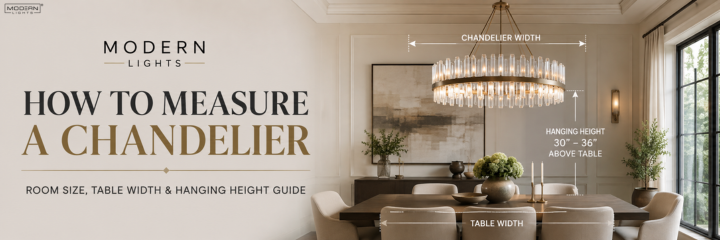
Buying a chandelier is easier when you know exactly how much space you have. The right fixture should be proportional to the room, fit comfortably above your table or island, and leave enough clearance for everyday movement.
To find the approximate diameter of the chandelier in inches, add the length and width of your room in feet. Choose a chandelier that is about ½ to ⅔ the width of your table and hang it 30–36 inches above the tabletop over a dining table.
These measurements are guidelines, not rules. Your final choice is also influenced by the chandelier’s design, visual weight, ceiling height, furniture and room layout – see how different styles read at different sizes in our full chandelier collection.
What Measurements Do You Need for a Chandelier?
Before shopping, have these measurements ready:
- Room length and width
- Ceiling height
- Dining table or kitchen island length and width
- Available hanging height
- Chandelier width or diameter
- Chandelier overall height
- Chain, rod, or downrod length
- Clearance around the fixture
- Electrical box and mounting location
These numbers make it easy to compare chandelier sizes and confirm a fixture will work in your space.
How to Measure Your Room for a Chandelier
1. Measure the room length
Measure from one wall to the opposite wall at the point where the chandelier will be positioned.
2. Measure the room width
Measure the perpendicular wall-to-wall distance.
Both are measured in feet and inches. If your room is not rectangular, think of the main area that the chandelier will illuminate instead of considering the entire open floor plan as one room. The size of your room determines the overall scale of the chandelier.
How to Calculate Chandelier Diameter
Add the length and width of the room in feet. This is the way interior designers and lighting retailers calculate the starting point for sizing. Take that number as the approximate chandelier diameter in inches.
Example: 12 ft + 16 ft = 28 inches
Another example: 10 ft + 12 ft = 22 inches
This formula works best as a starting point for dining rooms, bedrooms, living rooms, and other enclosed spaces.
Don’t follow it blindly. A large chandelier with a heavy, dense design feels larger than an open-frame fixture of the same size. The size of the furniture and ceiling height also impact the look of the chandelier — our statement chandelier guide breaks down how visual weight factors into sizing.
Can a Chandelier Be Larger Than the Formula Suggests?
Yes. The room size formula is a starting point, not a maximum. In a spacious room with high ceilings and substantial furniture, you can support a larger statement chandelier. Open concept spaces usually require a larger fixture to keep things looking balanced. Consider both physical size and visual weight simultaneously.
How to Measure Ceiling Height for a Chandelier
Measure from the finished floor to the ceiling directly below the desired mounting location. The ceiling and how tall it is vertically also has an impact on how low the chandelier can hang.
8-Foot Ceilings
If your ceilings are low, choose compact chandeliers or fixtures that have a shallow vertical profile. Avoid anything too tall, as this will make the room feel closed in.
9- to 10-Foot Ceilings
They give you more options, with a greater variety of styles and slightly taller fixtures, while still maintaining comfortable clearance.
High or Vaulted Ceilings
Multi-tier and elongated styles are tall chandeliers that are suitable for high ceilings. A fixture that is too small looks visually lost in these spaces. Make sure that the chandelier requires a compatible canopy, swivel or adjustable mounting system if you have vaulted or sloped ceilings.
How to Measure a Dining Table for a Chandelier
When a chandelier hangs above a dining table, the table's dimensions become the most important sizing reference. Measure:
- Table length
- Table width
- Distance from the table to surrounding walls
- Available space around dining chairs
The chandelier should complement the table, not overwhelm it.
How Big Should a Chandelier Be Over a Dining Table?
Choose a chandelier about ½ to ⅔ the width of the dining table.
For a 60-inch-wide table:
60 × ½ = 30 inches
60 × ⅔ = 40 inches
That puts you in a 30–40 inch range. For a rectangular table, a linear chandelier works especially well because its elongated shape follows the table's proportions.
That's in the 30-40 inch range. A Island Chandelier is a natural fit for a rectangular table, as the long shape is complementary to the table proportions.
How High Should a Chandelier Hang Above a Dining Table?
Hang the bottom of the fixture 30–36 inches above the tabletop. That range balances illumination, visibility, and visual connection to the table.
The exact height still depends on:
- Ceiling height
- Chandelier size
- Fixture design
- People's height
- Dining room layout
- Personal preference
Sit at the table and check the sightline across it before finalizing the height. The chandelier shouldn't block conversation or dominate eye level.
How to Measure for a Chandelier Over a Kitchen Island
For a chandelier or decorative pendant above a kitchen island, measure:
- Length
- Width
- Ceiling height
- Available clearance
- Seating positions
For one large chandelier, choose a fixture that coordinates with the island but isn’t much larger than it. Longer islands look better with a number of smaller fixtures . First measure the total area for the installation and spread the lights evenly over the area . Both the fixture diameter and the spacing between each need to be considered .
The goal is even illumination and balanced spacing, not filling every available inch.
How to Choose Chandelier Size by Room
Vertical height: Ceiling height (ft) × 2.5–3 = Fixture height (in.)
| Room | Most Important Measurements | Formula | Key Consideration |
|---|---|---|---|
| Dining room | Room + table | Room L + W = diameter; Table width × ½–⅔ = chandelier width | Chandelier width and table clearance |
| Living room | Room + ceiling | Room L + W = diameter; Ceiling ht × 2.5–3 = fixture height | Overall scale and furniture |
| Kitchen | Island + ceiling | Island width × 0.5–0.75 = single fixture width | Fixture size and spacing |
| Bedroom | Room + bed | Room L + W = diameter (scale down 10–15% if crowded) | Proportion and visual weight |
| Foyer | Ceiling + floor area | Ceiling ht × 2.5–3 = fixture height | Vertical height and traffic |
| Entryway | Ceiling + walkway | Room L + W = diameter | Clearance and sightlines |
For rooms without a table or island, use room dimensions and ceiling height as your primary references.

Don't Forget the Chandelier's Actual Dimensions
Before purchasing, compare your measurements with the manufacturer's specifications:
- Overall width or diameter
- Overall height
- Canopy diameter
- Minimum hanging height
- Maximum hanging height
- Chain length
- Rod or downrod length
- Number of tiers
- Bulb and shade dimensions
- Installation requirements
A chandelier’s advertised diameter doesn’t tell you how much vertical space it needs. A 30-inch-wide chandelier may also be 36 inches tall—that vertical measurement is a real difference on an 8-foot ceiling.
Some Top Picks


Common Chandelier Measuring Mistakes
Choosing by appearance alone
A chandelier can look perfect in a product photo but be too large or too small once installed. Check the actual dimensions every time.
Ignoring the ceiling height
A fixture can have the correct diameter but still be too tall for the room.
Measuring the room but not the furniture
For dining rooms and kitchens, the table or island is your key reference point.
Forgetting the chain or downrod
Include the canopy, chain, rods, and fixture body when calculating total hanging height.
Centering the fixture in the room instead of over the table
Center a dining chandelier over the dining table — even if the table isn't perfectly centered in the room.
Treating sizing formulas as exact rules
Room-sizing formulas are useful starting points, but visual proportion matters too. A delicate chandelier and a solid, ornate chandelier of the same size don't carry the same visual impact.
Chandelier Measurement Cheat Sheet
- Room-based diameter: Add room length and width in feet to estimate diameter in inches.
- Dining table chandelier: Aim for ½–⅔ of the table's width.
- Dining table height: Start around 30–36 inches above the tabletop.
- High ceilings: Consider taller or multi-tier fixtures.
- Low ceilings: Look for compact or semi-flush designs.
- Linear fixtures: Compare the fixture's length with the table or island.
- Final check: Always verify the manufacturer's actual dimensions and installation requirements.
Frequently Asked Questions
How do I know what size chandelier I need?
Add your room's length and width in feet — the result is your approximate chandelier diameter in inches. A 12-by-16-foot room calls for roughly a 28-inch chandelier.
How big should a chandelier be over a dining table?
Aim for ½ to ⅔ of your dining table's width. A 60-inch table works well with a chandelier around 30–40 inches wide.
How high should a chandelier hang above a dining table?
Hang it 30–36 inches above the tabletop, then adjust for your ceiling height and sightlines.
Can a chandelier be too big for a room?
Yes. An oversized chandelier overwhelms the room and interferes with sightlines. Large rooms and high ceilings can handle bigger fixtures, but scale still matters.
Can a chandelier be too small?
Yes. An undersized chandelier looks disconnected from the room and furniture. Weigh both physical dimensions and visual weight.
How do I size a chandelier for a high ceiling?
Factor in the room's width and the ceiling's vertical scale together. Taller, elongated, or multi-tier chandeliers give high-ceilinged rooms enough visual presence.
Should a chandelier be centered over the room or dining table?
Center it over the table, not the room's geometric center. The same rule applies above kitchen islands.
Final Thoughts
Before buying a chandelier, measure your space to avoid headaches with sizing and installation. Start with the length and width of the room to estimate diameter. Measure the height of the ceiling, and if relevant, the dining table or kitchen island. Then compare those numbers to the actual width and height and hanging range and installation requirements of the chandelier.
The best chandelier isn’t the biggest or most decorative—it’s the one that’s in proportion to the space, properly placed, comfortable to live with, and sized right for the furniture and ceiling height. See our entire lighting range for a match to your room.
Share:
Why Your LED Flickers When You Dim It (And How to Fix It)
What Is an Exit Sign and How Does It Work?