
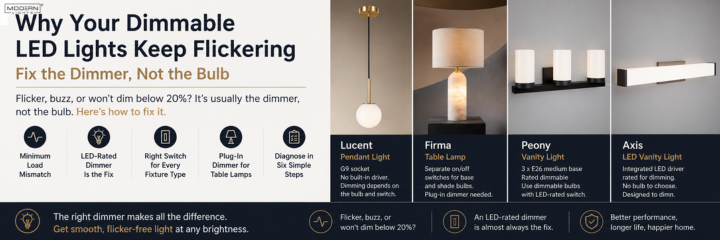
Dimmed LED lights flicker due to a mismatch between the dimmer switch and the LED load, not because of a bad bulb. The 6W to 9W LED load is well below the load of about 40W to 60W required to be loadable by legacy TRIAC dimmers, so the dimmer cannot hold a steady signal.
- Flicker only while dimming, steady at full brightness: replace the dimmer with an LED-rated model.
- Flicker at full brightness, or on some bulbs only: the bulb is the problem.
- Hardwired fixtures need an LED-rated wall dimmer (ELV or reverse phase).
- Table lamps need a plug-in LED-rated lamp dimmer, no wiring involved.
- Integrated LED fixtures still need an LED-rated switch even with the driver built in.
- Flicker, buzz, and a light that will not dim below 20% all trace back to the same cause: minimum load mismatch.
- TRIAC dimmers chop the AC waveform. LED drivers are electronic and many cannot read a chopped wave at low wattage.
- An LED-rated dimmer is a cheaper fix than replacing a fixture, and it is usually the correct one.
- Multi-bulb fixtures need the combined wattage of every bulb inside the dimmer's rated range.
- Fixture type decides the fix: plug-in dimmer for lamps, ELV wall dimmer for hardwired, LED-rated switch for integrated LED.
You dim the lights for dinner, and the pendant above your table starts flickering or, worse, buzzing. Your first thought is that the bulb is broken. It’s not nine out of ten times. LED bulbs don’t work the same way as the incandescent bulbs your dimmer switch was built for, and that’s almost always the reason you get the flicker, the hum, or the stubborn refusal to go below 20%.
This guide explains it simply, no electrician talk: Which of our fixtures dim cleanly right out of the box? Which ones depend on the bulb or switch you use with them? When can you fix it by swapping the bulb, and when do you need a new wall dimmer? Some real examples are the Lucent brass pendant, the Firma table lamp, the Peony vanity light, and the Axis LED vanity light. Each of these lights dims slightly differently.
Fixtures featured in this guide

Beacon Lighting
Lucent 1 Light Brass Pendant Light 4 Inch Alabaster
G9 socket, no built-in driver. Dimming depends on the bulb and switch.
$211.65 $249.00

Beacon Lighting
Firma 2 Light Linen Table Lamp with Alabaster Base
Separate on/off switches for base and shade bulbs. Plug-in dimmer needed.
$265.05 $279.00
Vinci Lighting
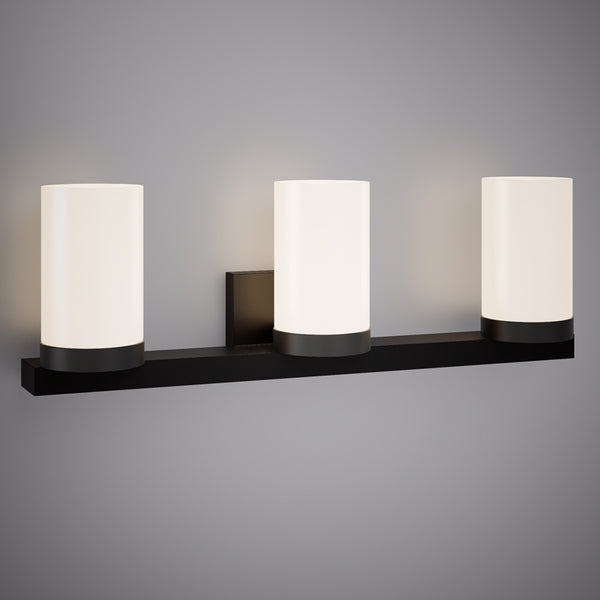
Peony 3-Light 23-in Matte Black Vanity Light Dimmable 180W
3 x E26 medium base, rated dimmable, 120V.
$83.00
View product
Vinci Lighting
Axis 36-in Matte Black Vanity Light Dimmable 30W
Integrated LED driver rated for dimming, 2400 lumens, no bulb to choose.
$120.00
View productPrices shown at the time of publishing. Check the product page for current pricing and stock.
Which of Our Fixtures Are Actually Dimmable?
Of the four, two are dimmable right out of the gate with dimming built into the spec sheet. The Peony 3-Light Vanity Light uses 3 E26 bulbs and is rated dimmable, so you can use it with dimmable E26 bulbs and an LED-rated switch for smooth control. The Axis LED Vanity Light takes it a step further: It has an integrated 20W LED driver rated for dimming, so there’s no bulb to select—the fixture itself is designed to dim.

Peony 3-Light 23-in Matte Black Vanity Light Dimmable 180W
Dimmable: Yes | 3 x E26 medium base | 120V | Damp and dry rated
$83.00

Axis 36-in Matte Black Vanity Light Dimmable 30W
Dimmable: Yes | Integrated LED | 2400 lumens | CRI 90 | 120V
$120.00
The other two are not as obvious. The brass pendant from Lucent has a G9 socket, with no driver built in, so whether or not it dims smoothly is all down to the G9 bulb you put in, and the wall switch behind it. The Firma table lamp has separate on/off switches for the G9 base bulb and the E26 shade bulb—it's not configured to dim at all as sold.

Lucent 1 Light Brass Pendant Light 4 Inch Alabaster
G9 socket | Spanish alabaster diffuser | Satin brass finish
$211.65 $249.00

Firma 2 Light Linen Table Lamp with Alabaster Base
G9 base bulb + E26 shade bulb | Independent on/off control | 16.5 inch
$265.05 $279.00
The Minimum Load Problem, In Plain Terms
Old dimmers were designed for incandescent bulbs that draw real wattage, 40, 60, or sometimes 100 watts. LEDs are power guzzlers, usually under 10 watts per bulb. Most legacy dimmers need a minimum load (commonly 40–60W total) just to read the circuit correctly. If you put a 6- to 9-watt LED alone on a dimmer that's designed for that minimum, the dimmer can't get a stable read on it. It’s like a bathroom scale trying to weigh a letter; it will give you something, but it won’t be steady, and it won’t be accurate.
Why an Old Dimmer Fails on an LED Load
Standard dimmers use TRIAC (leading-edge) technology that chops the electrical wave to reduce the power going to the bulb. Incandescent filaments are a simple resistive load, so they can handle that chopping smoothly. LED drivers are electronic components, and many of them were not made to read a chopped, unstable wave at low wattage. The driver misreads the signal (flicker). The driver hears a struggle to regulate the signal (buzz). The driver cuts out below a certain brightness percentage instead of dimming further. None of this means the bulb or fixture is defective — it means the switch behind the wall was never built for the load now connected to it.
Compatibility: Which Fixture Type Needs Which Switch
LED dimmer compatibility by fixture type
| Fixture type | What it needs |
|---|---|
| Table lamp (Firma) | Plug-in LED-rated lamp dimmer, or a smart dimmer plug — no wall wiring involved |
| Hardwired pendant (Lucent) | LED-rated wall dimmer (ELV/reverse-phase, or labeled "0–LED watts") |
| Integrated LED fixture (Axis) | Any dimmer explicitly rated for LED loads — check the fixture's minimum/maximum wattage window |
| Multi-bulb bar (Peony) | Combined wattage of all three bulbs must sit within the dimmer's rated range |
If a fixture's total wattage sits well under a dimmer's minimum load spec, that's the mismatch causing the flicker — not the fixture itself.
When to Replace the Switch Instead of the Light
If the flicker only shows up while dimming — and the fixture runs clean at full brightness — that's a switch problem, not a bulb problem.Keep changing the bulbs, and it won't help. Usually replacing the dimmer with an LED-rated one will, and it's cheaper than it sounds. Exception: If flicker happens at full brightness or flickers inconsistently across identical bulbs in the same fixture, then the bulb is the problem, not the switch.
Diagnose LED Flicker in Six Steps
Do these one after the other. Most cases are taken care of in step three, and you'll only need a screwdriver for the last two.
- Run the fixture at full brightnessLeave it at 100% for a few minutes. Steady at full and unstable only while dimming points to the switch. Unstable at both points to the bulb.
- Add up the wattage on the circuitTotal the wattage of every bulb controlled by that dimmer. If the total sits under about 40W, you are almost certainly below the dimmer's minimum load.
- Read the dimmer's own ratingCheck the label on the switch body or the packaging for an LED wattage rating. If it only lists an incandescent range, it was never built for the load you have on it.
- Move one bulb, not all of themSwap a suspect bulb into a different socket in the same fixture. If the flicker follows the bulb, replace that bulb. If it stays with the socket, keep looking at the circuit.
- Fit an LED-rated dimmerUse an ELV or reverse-phase wall dimmer for hardwired fixtures, and a plug-in LED-rated dimmer or smart plug for lamps. Hardwired work belongs to a licensed electrician.
- Recheck at the low endA matched dimmer should hold a steady output well below 20% with no buzz and no dropout. If it still misbehaves, the bulb or driver is the remaining variable.
Dimming Terms Explained
Dimmer and LED terminology
| Term | What it means |
|---|---|
| Minimum load | The lowest wattage a dimmer needs on the circuit to operate correctly. Legacy models commonly need 40W to 60W. |
| TRIAC (leading edge) | The older dimming method that cuts the front of the AC waveform. Built for resistive incandescent loads. |
| ELV (reverse phase / trailing edge) | The dimming method suited to electronic LED drivers. Smoother at the low end and quieter in operation. |
| Integrated LED | A fixture with the LED and driver built in, so there is no replaceable bulb. The Axis vanity light is one example. |
| Dropout | The point where a light cuts off completely instead of continuing to dim, often around 20% on a mismatched setup. |
| Dimmable bulb | An LED bulb whose driver is designed to respond to a dimmed supply. A non-dimmable LED will flicker or fail on any dimmer. |
FAQ
Can I use a regular dimmer with LED bulbs?
Not reliably. Standard TRIAC dimmers built for incandescent loads often cause flicker or buzz on LEDs because of the minimum load mismatch. Look for a dimmer explicitly rated for LED loads.
Why does my LED buzz but not flicker?
Buzzing usually means the dimmer is struggling to regulate the load electronically — audible but not visible. It's the same root cause as flicker, just expressed differently, and the fix is the same: an LED-rated dimmer.
Do integrated LED fixtures like the Axis need a special dimmer?
Yes. Even though the driver is built in, the wall switch controlling it still needs to be LED-rated. Check the fixture's minimum and maximum wattage window against your dimmer's spec sheet.
Is the Lucent pendant dimmable?
It depends on the G9 bulb you install, since the fixture has no built-in driver. Choose a dimmable G9 LED bulb and pair it with an LED-rated wall dimmer for smooth control.
Does the Firma table lamp dim?
Not as sold — it uses plain on/off switches for its base and shade bulbs. Adding a plug-in LED-rated lamp dimmer between the cord and outlet would let you dim it.
Why does my LED only dim to about 20% and then cut out?
That is dropout, and it happens when the load falls below what the dimmer can read. An ELV or reverse-phase dimmer rated for low LED wattage will usually carry the light much further down the range.
Can I mix LED and incandescent bulbs on the same dimmer?
It is not recommended. The two load types respond to the dimming curve differently, so brightness levels drift apart and flicker becomes more likely. Run one bulb technology per dimmer circuit.
Will a smart dimmer fix LED flicker?
Only if it is rated for LED loads. Smart control and LED compatibility are separate specifications. Check the LED wattage range on the product listing before buying, and confirm whether a neutral wire is required.
Does flickering damage an LED bulb?
Running an LED on a mismatched dimmer stresses the driver over time and can shorten its life, even though the fixture itself stays safe. Correcting the switch protects the bulbs you already own.
Do I need an electrician to change a dimmer switch?
For any hardwired fixture, yes. A licensed electrician handles wiring, secure mounting, and local code compliance. Plug-in lamp dimmers and smart plugs need no wiring work at all.
Conclusion
A flicker with a dimmer is almost always a mismatch, not a defect. Determine if your fixture is designed to dim, like the Peony and Axis, or if it is dependent on the bulb and switch you pair it with, like the Lucent pendant and Firma lamp. Match the wattage and type of dimmer to what the fixture requires, and the flicker disappears. Still seeing it after changing to a dimmer rated for LEDs? That’s something to look more closely at the bulb itself before blaming the fixture.
Share:
5 Best Chandeliers Under $200 for Every Room
How to Measure Your Space Before Buying a Chandelier?