
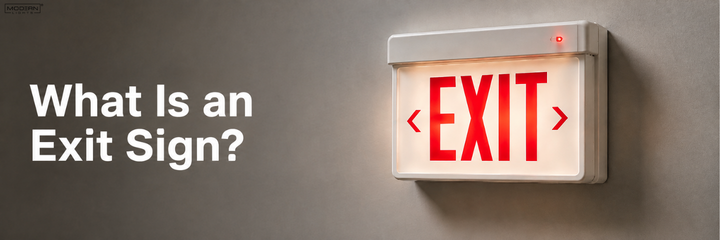
An exit sign is a life safety sign that uses illumination to indicate the way out of a building in an emergency. The building’s electrical system powers an exit sign, switches to an internal battery if that power fails, and stays lit for at least 90 minutes so occupants can find the nearest exit in darkness or smoke.
- Runtime: at least 90 minutes of emergency illumination, per NFPA 101.
- Legend size: EXIT letters at least 6 inches high with 3/4 inch strokes, per OSHA 1910.37.
- Illumination: at least 5 foot candles (54 lux) on the sign face.
- Spacing: no point in an exit access corridor more than 100 feet, or the rated viewing distance, from the nearest sign.
- Listing: UL 924 is the standard listing for exit signs and emergency lighting.
- Types: LED with battery backup, edge lit, exit and emergency combo, photoluminescent, self luminous tritium.
What Is an Exit Sign?
An exit sign is an illuminated sign that identifies an exit and marks the path of travel to it. The word EXIT is backlit, either by the sign itself or by an external source, so that the legend remains legible when the room lighting fails, or smoke obscures the view.
Exit signs are a means of egress. That is the system in a building that describes the path from any occupied space to a public way. Where the route is not obvious, it is marked by signs and the floor is lit by emergency lights along the route. The NFPA 101, the International Building Code and OSHA 29 CFR 1910.37 all say that virtually every commercial occupancy requires them, including offices, retail, schools, hospitals, hotels, restaurants, and warehouses. Most have a UL 924 listing, which is what an inspector looks for on the label. An unlisted decorative EXIT plaque does not comply with code, no matter how bright it looks.
How Does an Exit Sign Work?
An exit sign works by being constantly lit on building power while simultaneously charging an internal battery. Then it switches to that battery automatically the instant normal power is lost. The transfer takes a fraction of a second, so the legend never dies.
What Powers an Exit Sign?
Most signs are AC-powered, with battery backup, and wired to a 120V or 277V circuit. Many units will accept both on a universal input. A sensing circuit detects the incoming voltage, and a transfer relay switches the LED board to battery power when it dips. There are two non-electrical options as well. Self-luminous signs use sealed tritium gas tubes that glow by themselves for 10 to 20 years. Photoluminescent signs absorb light from the environment during occupied hours and emit it during off hours.
What Is Inside an Exit Sign?
An LED exit sign consists of four components: LED modules to illuminate the stencil or edge-lit panel at approximately 2 to 5 watts, a circuit board to manage charging and sense power loss, a nickel-cadmium or sealed lead acid battery pack, and a thermoplastic or die-cast aluminum housing with a universal canopy for ceiling, wall, or end mounting. Self-diagnostic models add a microprocessor to test the unit on a schedule and report faults through a status LED.
How Long Does an Exit Sign Stay On in an Outage?
An exit sign must remain lit for at least 90 minutes after normal power is lost. NFPA 101 sets that number for both exit signs and emergency lighting. Emergency lighting has a corresponding requirement of 1 footcandle average at floor level along the egress path. The 90 minutes only exist if the battery is healthy, which is why testing is inside the code and not a maintenance suggestion.
What Are the Types of Exit Signs?
There are five basic types of exit signs: LED with battery backup, edge-lit LED, exit and emergency combo units, photoluminescent, and self-luminous tritium. The choice depends on the needs of the environment and whether there is power at the mounting point. Face configuration is also important. Single face is appropriate for one-way approach. Double-faced is appropriate for two-way corridors. Damp or wet location ratings include garages, exterior doors, and washdown areas.
Exit sign types compared
| Type | Power Source | Service Life | Best For |
|---|---|---|---|
| LED with battery backup | AC 120V or 277V plus internal battery | 10 years or more, 4 to 5 years per battery | Offices, retail, schools, most commercial interiors |
| Edge lit LED | AC 120V or 277V plus internal battery | 10 years or more | Lobbies, hotels, and design led spaces |
| Exit and emergency combo | AC 120V or 277V plus internal battery | 10 years or more | Stairwells and corridors needing signage plus floor light |
| Photoluminescent | Ambient light, no wiring | Typically 25 years, no battery | Retrofits with no circuit available |
| Self luminous (tritium) | None, self powered | Roughly 10 to 20 years | Remote, unheated, or hard to wire locations |
What Are the Code Requirements for Exit Signs?
Exit sign requirements are derived from OSHA 29 CFR 1910.37 (workplaces), NFPA 101 (building egress), and the International Building Code (product listing standard is UL 924). Placement follows the path people walk. Each required exit door, each turn and intersection of corridors, stairwells, and the exit discharge. Closet doors and mechanical rooms that look like exits but are not should be labeled 'Not an Exit'.
Core exit sign requirements at a glance
| Requirement | What the code says | Source |
|---|---|---|
| Letter size | At least 6 inches high with 3/4 inch principal strokes. Existing 4 inch signs are permitted where already installed | OSHA 1910.37(b), NFPA 101 |
| Illumination | At least 5 foot candles (54 lux) on the sign face | OSHA 1910.37(b) |
| Self luminous brightness | At least 0.06 footlamberts (0.21 cd/m2) | OSHA 1910.37(b) |
| Emergency runtime | Minimum 90 minutes after normal power fails | NFPA 101 |
| Spacing | No point in an exit access corridor beyond the rated viewing distance or 100 feet, whichever is less | NFPA 101, 7.10.1.5.2 |
| Mounting height | Bottom of the sign no more than 80 inches above the top edge of the egress opening. Floor proximity signs mount 6 to 18 inches off the floor | NFPA 101, 7.10.1.6 |
| Legend and color | The word EXIT, with NFPA 170 running man pictograms permitted when approved. No fixed color nationally, only sufficient contrast | NFPA 101, 7.10.3 |
Verify locally before you buy. Codes are adopted and amended at the state and municipal level. The edition in force where the building is located may be different from the current published edition. Check with your local authority having jurisdiction or fire marshal for placement, legend color, and listing requirements before ordering.
How Do You Test and Maintain an Exit Sign?
Exit signs are tested monthly with a 30-second functional test and annually with a full 90-minute discharge test. Both results are logged. Signs are silent. Dead batteries give no warning until the power is actually out.
- Monthly visual check. Confirm the sign is lit, the lens is clean, and the line of sight is clear from every approach.
- Monthly functional test. Hold the test button for 30 seconds and watch the legend stay lit on battery power throughout.
- Annual duration test. Cut power for the full 90 minutes and confirm the legend is still readable at the end, not just faintly glowing.
- Record the result. Log the date, fixture location, and outcome. Inspectors ask for the log, not a verbal assurance.
- Replace the battery. Most packs last 4 to 5 years. A sign that passes 30 seconds but fades well before 90 minutes has a finished battery.
- Replace the fixture. Swap the whole unit when the housing cracks, the lens yellows, or the legend dims unevenly.
Exit Sign vs Emergency Light: What Is the Difference?
An exit sign is a directional sign that points out the exit, and an emergency light is an area fixture that illuminates the floor so people can walk safely. The exit sign is measured for legibility at its rated viewing distance and carries the EXIT legend and an arrow where the route turns. The emergency light has no legend and provides an average of 1 footcandle at floor level. Both are 90 minutes long.
The legend is on the face. Combo units combine both into one housing, with adjustable lamp heads on the sides or top. In a stairwell or back corridor, a single combo fixture can often do the job that would otherwise require two.
Frequently Asked Questions
How long do exit sign batteries last?
Exit sign batteries last 4 to 5 years on average. The battery has to hold at least 90 minutes of runtime to remain compliant, so a pack that fades early during the annual duration test should be replaced even if the sign still lights up on the 30 second test button.
Are exit signs required to be on 24/7?
Yes. Exit signs must stay illuminated continuously whenever a building is occupied, and in most commercial occupancies that means permanent illumination. An LED exit sign draws roughly 2 to 5 watts, so running one around the clock costs a few dollars a year.
What color should an exit sign be, red or green?
NFPA 101 does not mandate a color, only that the legend contrast enough with its background to be read easily. Some jurisdictions set their own rule. Green is required in Baltimore, Salt Lake City, and Portland, and California, Illinois, and Massachusetts require or recommend green in certain applications. Red remains the most common choice across most of the United States.
How far apart should exit signs be placed?
No point in an exit access corridor may be farther from the nearest sign than the sign's rated viewing distance or 100 feet, whichever is less. Most UL 924 listed signs with 6 inch letters are rated for 100 feet. A sign is also needed at every turn and intersection regardless of distance, because line of sight is the real requirement.
Can an exit sign run without electricity?
Yes. Self luminous tritium exit signs need no wiring and no batteries, and glow on their own for roughly 10 to 20 years. Photoluminescent exit signs also work without power, but they must be charged by ambient light during occupied hours and carry a UL 924 listing to satisfy code.
What does UL 924 mean on an exit sign?
UL 924 is the safety standard for emergency lighting and power equipment. A UL 924 listed exit sign has been tested for legend visibility, illumination level, transfer to emergency power, and 90 minute runtime. Inspectors look for the listing label, and unlisted decorative signs do not satisfy code.
How do you dispose of a tritium exit sign?
Tritium exit signs contain a radioactive gas and are regulated by the Nuclear Regulatory Commission or an equivalent state agency. They cannot go in regular waste. Return the sign to the manufacturer or a licensed recycler and keep the disposal record.
Choosing the Right Exit Sign
Begin with the layout. Count the doors, turns,, and sight lines and then determine where the single-face, double-face, and combo units go. Next, match the environment and select damp- or wet-location-rated housings where appropriate. Add self-diagnostic models wherever manual testing on a monthly basis across a large site is impractical. Confirm legend color with AHJ before ordering. Color change after installation requires fixture replacement.
Browse the full range of exit signs and emergency lighting at Modern Lights, including single face, double face, outdoor rated, and combo units from RP Lighting.

Runs its own scheduled tests and flags a failing battery on the face.
$147.90
View Product
Readable from both directions for corridors with two way traffic.
$39.90
View Product
Directional legend plus adjustable lamp heads in a single fixture.
$73.90
View Product
Built for exterior doors, loading docks, and covered walkways.
$273.90
View Product
Share:
How to Measure Your Space Before Buying a Chandelier?
How to Replace a Ceiling Fan Light Kit?