
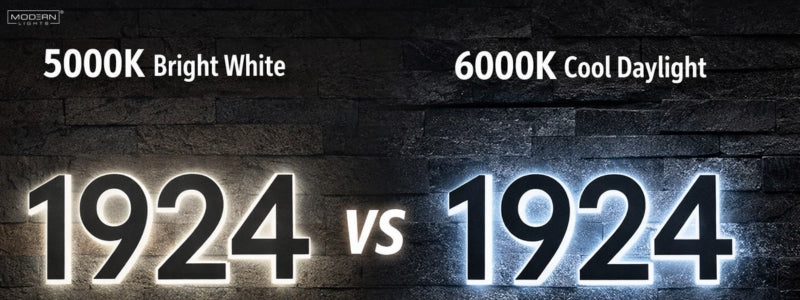
The visibility of house numerals at night is significantly influenced by lighting. Backlit address numbers are a popular option for contemporary homes because they blend practicality and elegant style. In addition to adding a modern architectural element to the exterior of the house, the lighting behind the numbers produces a gentle halo glow that makes the address visible from the street.
When choosing LED illuminated house numbers, one of the most essential selections is the color temperature of the lights. Whether the light seems neutral, bright white, or chilly daylight depends on the color temperature, which is expressed in Kelvin (K).
5000K and 6000K lights are two of the most popular choices for contemporary address signs. Although both emit bright white lights, their levels of visibility and visual effects differ slightly.
Knowing the distinctions between these two lighting hues can assist you in selecting the ideal choice for the exterior of your house, guaranteeing that your address is nonetheless visible while preserving the sleek, contemporary appearance that backlit numerals are renowned for.
Understanding LED Color Temperature for House Numbers
The way an LED produces light is described by its color temperature. It establishes whether the light seems warm, neutral, or chilly and is measured in Kelvin (K).
Higher Kelvin values result in brighter, colder light, whereas lower values provide warmer tones.
|
Color Temperature |
Appearance |
|
3000k |
Warm White |
|
4000k |
Neutral White |
|
5000k |
Bright White |
|
6000k |
Daylight White |
Cooler color temperatures are often used for backlit address numbers because they increase contrast and visibility at night. While brighter white lighting makes the numbers stand out from the surrounding surface, warm lighting might occasionally blend in with the outside wall background.
Both 5000K and 6000K lights fall into the cool white group, which makes them great options for contemporary address signs that need to be seen after dark.
Why Lighting Color Matters for Backlit Address Numbers
House numbers have a straightforward but crucial function: they make it easier for guests, delivery drivers, and emergency services to find a property. Numbers that are hard to see at night may cause needless confusion or delays. Backlit address numbers overcome this problem by illuminating the numbers from behind, providing a halo effect that boosts visibility. The hue of the lighting has a direct impact on how readable the numbers look from the street.
The contrast between the numbers and the wall behind them is enhanced by brighter white lighting. The address may be read from a farther distance because of this contrast.
The hue of the lighting also affects how the façade of the house looks overall. While some homeowners like a crisper daylight view that shines out more strongly, others choose a balanced white tone that mixes in with outdoor lighting.
The address numerals will continue to be both functional and visually appealing if the appropriate lighting hue is chosen.
What Is 5000K Lighting?
Bright neutral white is a popular description of 5000K lighting. It is frequently utilized in outdoor lighting applications and closely resembles natural sunshine. 5000K offers clear lighting for 5000K backlit house numbers that is balanced in tone and bright enough to be seen at night. It doesn't look soft or yellow like warmer lighting does. Rather, it produces a pure white radiance that goes well with contemporary external designs. Because it complements other outdoor lighting fixtures, including porch lights, walkway lighting, and garage lighting, 5000K lighting is a popular choice among homeowners.
Advantages of 5000K Backlit Address Numbers
5000K lighting offers several practical advantages when used for address numbers.
-
Clear and crisp illumination
-
Strong contrast on the darker exterior walls
-
Modern and balanced appearance
-
Comfortable brightness for residential areas
Because the light is bright without being overly harsh, it works well for homes located closer to the street, where extremely strong lighting is not necessary.
Potential Drawbacks of 5000K Lighting
Although 5000K lighting is effective in most residential situations, there are a few considerations.
-
Visibility may be slightly reduced on very dark streets
-
The halo glow may appear softer than colder lighting
-
Long driveways may benefit from brighter illumination
For homes located farther from the road, slightly brighter lighting may sometimes provide better visibility.
What Is 6000K Lighting?
Daylight white is another name for 6000K lighting. When compared to 5000K illumination, it creates a cooler and brighter appearance. 6000K lighting provides a crisp glow for 6000K backlit house numbers, making them easier to see from a greater distance due to the stronger contrast it creates.
The light tends to stand out more against external surfaces since it is stronger and colder. When maximum visibility is the top objective, a lot of contemporary address signs use lights in the 6000K range.
Advantages of 6000K Backlit Address Numbers
6000K lighting offers several benefits for homeowners who want maximum readability.
-
Very strong nighttime visibility
-
Brighter halo glow behind numbers
-
Excellent readability from a distance
-
Ideal for homes with long driveways
For properties located farther from the street, the brighter glow of 6000K lighting can make a noticeable difference in how easily the address can be seen.
Potential Drawbacks of 6000K Lighting
While 6000K lighting is highly visible, it may not always match every exterior design style.
-
The light may appear slightly cooler in tone
-
Small homes may not need extremely bright lighting
-
The brightness can feel stronger than necessary in well-lit neighborhoods
In some situations, homeowners prefer the more balanced appearance of 5000K lighting.
5000K vs 6000K: Side-by-Side Comparison
|
Feature |
5000k |
6000k |
|
Light color |
Bright neutral white |
Cool daylight white |
|
Brightness |
High |
Very high |
|
Visibility distance |
Excellent |
Maximum visibility |
|
Visual style |
Balanced modern look |
Bold modern look |
|
Best for |
Residential homes close to the street |
Large properties or long driveways |
Both lighting colors provide excellent visibility, but the best option depends on the layout of the property and the desired design style.
How Far Can Backlit Address Numbers Be Seen at Night?
A lot of variables affect visibility, such as the color of the lighting, the size of the numbers, and the contrast between the numbers and the wall.
Typical visibility ranges for backlit house numbers are:
|
Lighting Color |
Visibility Distance |
|
5000k |
80-120 feet |
|
6000k |
120-180 feet |
Stronger contrast is produced by cooler illumination, like 6000K, which makes the numbers visible from a farther distance.
However, for the majority of residential homes, even 5000K illumination offers good readability, particularly when the numbers are positioned and scaled correctly.
Why Clearly Visible House Numbers Matter for Emergency Services
In addition to being useful for visitors and deliveries, visible house numbers are crucial in emergencies. When responding to calls, police, firefighters, and paramedics depend on unambiguous address marks. Emergency personnel may lose valuable time attempting to find the right home if house numbers are hard to see at night. By guaranteeing that the address is visible even in low light, backlit address numbers assist in avoiding this issue.
The numerals may be immediately recognized from the street thanks to bright LED illumination and distinct contrast, increasing the likelihood of quick and precise position recognition.
How Lighting Color Affects Modern Home Design
Rather than being only a practical feature, backlit address numbers are frequently incorporated into a home's external decor.
The way the numerals blend in with the house's architecture depends on the hue of the lighting.
5000K lighting works well for
-
Modern residences
-
Neutral exterior colors
-
Types of minimalist design
6000K lighting works well for
-
Exterior walls that are darker
-
Modern or industrial architecture
-
Residences that require more contrast
The address numbers can become a subtle design element that improves the home's overall appeal by choosing the appropriate lighting color.
Which Lighting Color Is Best for Backlit Address Numbers?
The ideal choice will depend on your particular requirements; however, both lighting hues provide excellent performance.
Choose 5000K lighting if:
-
The street is closer to your house.
-
You want balanced brightness
-
You like a more subdued contemporary radiance.
Choose 6000K lighting if
-
Your driveway is quite lengthy.
-
The distance between your property and the road is greater.
-
You want to see as much as possible at night.
Both solutions offer outstanding readability in the majority of household settings. The choice frequently boils down to personal taste and external design aesthetics.
FAQ’s
Is 5000K bright enough for house numbers?
Yes. 5000K lighting provides strong illumination that works well for most homes. When address numbers are properly sized and placed, they remain clearly visible from the street.
Is 6000K too bright for residential homes?
Not necessarily. 6000K lighting is commonly used for exterior LED lighting. It produces a sharper glow that can improve visibility for homes located farther from the road.
Which lighting color looks more modern?
Both colors work well for modern designs. 5000K offers a balanced white appearance, while 6000K creates a cooler daylight look.
Do LED backlit house numbers use a lot of electricity?
LED lighting is very energy efficient. Backlit address numbers typically use minimal power while providing consistent illumination throughout the night.
Conclusion
Both visibility and external design can be enhanced by selecting the appropriate lighting hue for backlit address numbers. Most homes may benefit from the balanced white glow of 5000K lighting, which offers good vision without looking too bright. A stronger daytime tone produced by 6000K lighting can improve contrast and make address numerals more visible from farther away.
Both choices guarantee that the address is visible after dark while maintaining a tidy and contemporary appearance. The layout of your property, the distance from the street, and the external design style you desire will ultimately determine the best option.
Share:
2700K vs 5000K Backlit Address Numbers : Which is Better?
How to Choose the Right Light Fixture Size for Any Room?