
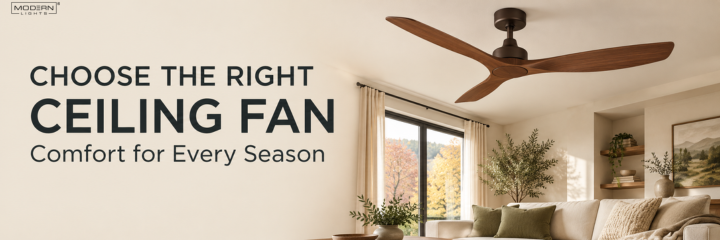
Start with room size – 29- to 36-inches for small rooms, 42 to 48 inches for medium rooms and 52 inches or bigger for large spaces. Then check the ceiling height, CFM airflow, and motor type. Get a reversible fan, preferably a DC fan with a remote, so you can run it clockwise on low in fall and winter. For outdoor, select the damp or wet rating appropriate for the space, and add integrated lighting only if the room requires it.
Most people purchase a ceiling fan as a summer purchase. In the cooler evenings, the switch goes off, and the fan is idle until June. But a well-chosen fan can still be a useful tool as the seasons change, circulating air on hot days and helping to push out stagnant heat when it’s cool.
Consider a few things when choosing the right one: room size, airflow, ceiling height, motor efficiency, seasonal direction, lighting, and design. The best fan depends on the room, the installation conditions, and how you plan to use it.
This guide walks through each factor and features five fans from Modern Lights, chosen for large living rooms, low ceilings, bedrooms, outdoor areas, and compact spaces.
1. Understand How a Ceiling Fan Keeps Your Home Comfortable Year-Round
In warm weather, a ceiling fan cools you off by creating a wind-chill effect. Moving air takes heat away from your skin, so the room feels cooler even if the thermostat reading hasn't changed.
Job changes in the cold months. Warm air rises and collects near the ceiling, leaving the living space cooler than it should be. Run the fan backward at low speed, and it pulls air upward, nudging that warmth back down along the walls without any noticeable draft.
The difference is that summer mode creates a breeze, while winter mode gently circulates air. A fan won’t replace your heating system. Neither will heat. It just helps move the heat you already have to where you sit.
This is why reversible operation is one of the most useful features for year-round use.
2. Choose the Right Ceiling Fan Size for Your Room
Most fan purchases go wrong with size. A fan that’s too small does little to move the air, and one that’s too large can feel overwhelming and look out of scale. Factors include blade span, room size, layout, and airflow needs.
As a general guide:
- Small rooms: approximately 29 to 36 inches
- Medium rooms: approximately 42 to 48 inches
- Larger rooms: approximately 52 inches or larger
Open-plan spaces are harder to gauge. If you have a long living and dining area you may need a larger fan or two fans placed over each zone.
But blade span is only part of the story. CFM measures airflow, or cubic feet per minute. It tells you how much air the fan is actually moving. Two fans of the same span can be very different in their performance so compare size and CFM together. Check the low as well as the high figure, for low speed is what you're going to use most in fall.
Finally, follow the manufacturer's guidance on room suitability and blade clearance. A fan that fits the floor plan still has to fit the space safely.
Best for Large Living Rooms: Akmani 60-Inch Bronze Ceiling Fan

Akmani 60 Inch Bronze Fan with 0 Lights and Remote
60-inch · DC motor · 6 speeds · 1,519 to 7,074 CFM
$449.00$589.00Save 24%
The Akmani has decent reach for a large living room or open-plan space. It has a 60-inch span, a six-speed DC motor and a stated airflow range of 1,519 to 7,074 CFM, which is enough for a strong summer breeze and a gentle low setting in the fall.
Oil-rubbed bronze finish with rich Koa tone solid wood blades for a warm, natural look. It doesn’t have a built-in light, which makes it great for rooms that already have lamps or recessed lighting. If airflow capacity and a warm finish are high on your list of priorities, then this is the one for you.
3. Check Ceiling Height and Mounting Requirements
The ceiling height will determine how the fan is mounted. Hugger or flush-mount fans sit close to the ceiling and are designed for lower rooms. Downrod fans hang from a metal rod that lowers the blades into the room, which suits taller ceilings where a flush fan would sit too high to move air well.
On a low ceiling, two measurements matter: the fan's total installed drop, from the ceiling to the bottom of the fixture, and the clearance between the blades and the floor. A fan that hangs too low is uncomfortable to walk under and may not meet installation guidelines.
Add another step for sloped or vaulted ceilings. Many fans need an angled mounting kit or longer downrod to hang level and clear the slope.
Before you buy, check mounting compatibility for your ceiling and read the installation instructions.
Best for Low Ceilings: Emiko-H 56-Inch Reversible DC LED Ceiling Fan

Emiko-H 56-in Matte Black Reversible DC LED Ceiling Fan
56-inch · Hugger mount · Dimmable 3000K LED · Damp rated
$499.20$624.00Save 20%
The Emiko-H is built for rooms where headroom is tight. Its hugger-style mount has a stated drop of 10.75 inches, and its 56-inch span suits rooms up to roughly 300 square feet, depending on layout and conditions.
The reversible DC motor handles both seasons, and the dimmable 3000K LED can serve as the room's main light. The matte black finish reads clean against a light ceiling, and the damp rating extends its use to bathrooms and covered porches. Confirm your actual ceiling clearance and check that the rating suits the location.
4. Compare Airflow, Motor Efficiency, and Noise
Once you figure out the right size and mounting, compare how the fan performs. Start with CFM. A higher figure means more air moved, but the full range is also important. A fan that has a large range between low and high speed will transition better throughout the seasons.
The wattage is an indication of how much the airflow will cost to run. See it with CFM and speed, not in isolation. That fan that draws only a few watts on low may draw a lot more at full speed.
Many DC motor fans offer efficient operation and six speed settings, compared with three on many AC models. Performance still varies from one model to the next, so check each listing.
Noise matters most in bedrooms, offices, and living rooms where you spend quiet hours. Review the specifications, controls, and warranty details rather than choosing on looks alone.
5. Choose a Reversible Ceiling Fan for Fall and Winter
Seasonal direction follows a simple pattern. In summer, most fans should spin counterclockwise when viewed from below, pushing air straight down to create a cooling breeze. In fall and winter, switch to clockwise at a low speed. This draws air up toward the ceiling and circulates warmer air back down into the room.
How you change direction depends on the model. Some fans reverse from the remote, others from a wall control, and some from a manual switch on the motor housing. A remote or wall control makes the change easy enough that you'll actually do it each season.
Keep expectations realistic. Reversing a fan doesn't create extra heat. It moves the warm air you already have so it isn't wasted at the ceiling.
That's what makes a reversible fan worth having as the seasons change. It’s a fixture that keeps you cool through late summer and helps the room feel more even once the heat turns on.
Best for Bedrooms and Medium Rooms: 52-Inch DC Bronze Ceiling Fan

52 Inch DC Bronze Fan with Reversible Koa Walnut Blades and Remote
52-inch · DC motor · Remote reversal · About 30W average
$269.00$349.00Save 23%
This 52-inch fan fits well in properly sized bedrooms and medium rooms without crowding the ceiling. You can run seasonal reversal from the remote so winter mode is one button press away. The airflow is rated at between 2,322 and 4,638 CFM, and the average power consumption is around 30W, although this varies per speed.
The blades are also reversible, with dark koa on one side and aged wood on the other. For shoppers looking at function, finish, and price, it’s a good place to start.
6. Select the Right Ceiling Fan for Outdoor Spaces
Fans for outdoor use need a rating that matches the amount of weather they will see. Damp-rated fans can withstand humidity and moisture, but not rain, so they’re good for covered porches and screened-in patios. Wet-rated fans are made for direct exposure to rain and spray. They’re the best choice for uncovered pergolas, open patios, and decks.
That's a big difference. An interior fan in an outside location, or a damp-rated fan in an exposed location, can rust, warp, or develop electrical faults. It’s not just weather protection. Proper electrical installation is just as important, especially on outside structures and mounting hardware.
Before buying, look honestly at the spot. Does rain reach it when the wind picks up? If so, check that the fan's rating covers that exposure, not just the roof overhead.
Best for Patios and Pergolas: Abyss 56-Inch Wet-Rated Ceiling Fan

Abyss 56 Inch Black DC Fan IP66 Wet Rated
56-inch · IP66 wet rated · DC motor · 6 speeds
$379.00$499.00Save 24%
The Abyss is made for outdoor spaces with real exposure. Its IP66 rating means the ABS polymer housing and blades resist moisture, humidity, and harsh weather, suiting patio and pergola installations.
The 56-inch span provides a generous seating area and an airflow range of 1,519 to 7,074 CFM over six speeds. The Speed and seasonal reversal are controlled by the remote, and the black finish keeps it contemporary. Please be aware that the 3W draw detailed above is for low speed; at full power the motor draws up to 26W. Follow installation requirements from the manufacturer for your space.
7. Decide Whether You Need a Ceiling Fan With Lights
Not every fan has to have a light. Integrated LED lighting makes sense if the fan is in the middle of a room and there is no other overhead fixture. It can even replace a separate ceiling light altogether and keep the ceiling clutter-free.
A fan without a light often looks cleaner and doesn’t double up in rooms already lit by pendants, recessed lights or lamps.
If you do want a light, check its brightness, dimming, and color temperature. 2700K gives off a warm, relaxed glow, which is best for bedrooms and living areas. 3000K is a little crisper. Dimming lets one fixture serve busy evenings and quiet nights.
Also consider lighting and airflow, installation, and controls. It is much easier to live with one remote that controls the fan and the light than to have two separate switches.
Best for Small Rooms and a Space-Saving Design: 36-Inch Retractable Blade Ceiling Fan

36 Inch Matte Black Retractable Blade Ceiling Fan
36-inch · Retractable blades · 2 dimmable 2700K LEDs · AC motor
$269.00$349.00Save 23%
This little fan is perfect for bedrooms, home offices, and cozy living spaces. The blades extend when the fan is on. They retract when the fan is off. So it looks more like a light fixture when it is off.
The two dimmable 2700K LED lights create a warm glow, and a seasonal switch manages direction changes for cooler months. Rated for indoor or covered outdoor use (as per manufacturer’s instructions). It’s different from the other four fans here in that it has an AC motor with three speeds, so go for it if you want a compact fan with built-in lighting.
8. Match Your Ceiling Fan to Your Interior Design
The finish of a ceiling fan matters because it is one of the largest fixtures in a room. Bronze and wood tones add warmth to traditional, rustic, and transitional spaces, and pair well with the richer palettes many homes gravitate toward in the fall. Matte black is a good look in contemporary rooms, especially with pale ceilings, while streamlined or retractable blades keep the feel calm in minimalist spaces.
See what is already there: flooring, furniture, lighting, and cabinetry. Choosing modern ceiling fans in a finish that matches those details makes the fan feel intentional, not like an afterthought.
Design should allow for real choices, not impose choices. Select the size, airflow, and mounting clearance first, then the finish.
9. Compare the Five Ceiling Fans Before Buying
Comparing the five fans side by side helps you narrow your options by room and installation needs.
Ceiling Fan Comparison
| Product | Best for | Main buying consideration |
|---|---|---|
| Akmani 60-inch Bronze | Large living rooms | High stated airflow and solid wood blades |
| Emiko-H 56-inch | Low ceilings | Hugger mounting and integrated LED |
| 52-inch DC Bronze | Bedrooms and medium rooms | Reversible operation and wood finishes |
| Abyss 56-inch Black | Suitable outdoor areas | IP66 wet-rated construction |
| 36-inch Retractable | Small rooms | Retractable blades and integrated lighting |
Before you choose, compare current prices, airflow, motor type, mounting requirements, and lighting on each product page, since details can change.
No single fan is right for every room. A 60-inch fan suited to an open living area would overwhelm a small bedroom, and a hugger built for low ceilings would look undersized in a tall great room. The best choice depends on your room and where the fan will be installed.
10. Why Buy Your Ceiling Fan from ModernLights.com?
ModernLights.com has a huge selection of ceiling fans in a variety of sizes, finishes, and styles. From small retractable fans to large DC fans to outdoor wet-rated fans, we have them all. Each product page has the specs that count, so you can do a proper comparison of options before you decide.
Use those details.” The fan you use year-round vs. the one that sits idle after summer comes down to airflow, motor type, seasonal reversal, lighting, and environmental rating.
This guide’s five fans show how some fans are better for certain needs: a large living room, a low ceiling, a bedroom, an outdoor patio and a small room. If none fit your space exactly, the full collection has plenty more to compare, with free shipping on orders over $99.
Explore the ceiling fan collection at ModernLights.com to compare available styles and features and find the right fit for your space.
Shop Ceiling Fans at ModernLights.comFrequently Asked Questions
Which way should a ceiling fan spin in fall?
Clockwise at low speed, when viewed from below. This helps push warm air from the ceiling back into the room without a chilly breeze.
What size ceiling fan is best for a large living room?
Usually 52 inches or larger, but room dimensions, layout, ceiling height, and airflow needs decide the right size. Open-plan rooms may need two fans.
Are DC ceiling fans more energy-efficient than AC fans?
Many DC models use less electricity, but compare the actual wattage and CFM of the fans you're considering before deciding.
Can I use an outdoor ceiling fan on a covered patio?
Yes, as long as its rating matches the moisture exposure. Damp-rated fans suit covered spaces, while spots exposed to rain need a wet-rated fan.
Is a ceiling fan with an integrated light worth buying?
It is if the fan will be the room's main overhead light. If the room already has enough lighting, a fan without one keeps things simpler.
Choosing a Fan That Works All Year
The right ceiling fan comes down to a few clear checks: room size, airflow, mounting clearance, seasonal reversal, motor performance, lighting, and environmental rating. Get those right, and the fan earns its place in fall and winter as much as in summer.
The five fans here each solve a different problem, and none is the single best choice for every home. Compare the specifications, think about how you use the room, then explore the Modern Lights ceiling fan collection to find the fan that fits.
Share:
Best Wall Sconces for Bedrooms, Hallways and Bathrooms