
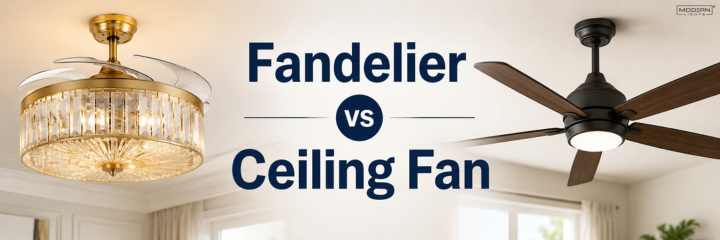
A fandelier is a fan and chandelier combo light fixture with a fan motor built into it, giving you 1,500 to 4,000 lumens but only 1,000 to 3,500 CFM of airflow. A ceiling fan is an air-moving fixture with an optional light kit that provides 4,000-6,500 CFM but usually under 1,600 lumens.
If you have a room with 9-foot ceilings and the fixture is the only source of light, buy a fandelier for rooms up to 225 sq ft. Ceiling fans are for rooms over 300 sq ft, 8-foot ceilings, or any room where the real goal is cooling.
Both fixtures are rotating. The only one of them is made to cool a room. This guide compares fan and ceiling fans on airflow, lumens, blade span, ceiling height, and cost and then tells you which one to buy for the room you're working on.
Fandelier vs Ceiling Fan Comparison Chart
A fandelier puts its budget, weight, and physical volume into light output and appearance. A ceiling fan provides equal resources to blade span and motor torque. Each row below is just that one tradeoff repeated.
| Feature | Fandelier | Ceiling Fan |
|---|---|---|
| Primary purpose | Decorative light with airflow support | Air circulation with optional light |
| Blade span | 20 to 44 inches | 42 to 60 inches |
| Airflow (CFM) | 1,000 to 3,500 | 1,500 to 6,500 |
| Light output | 1,500 to 4,000 lumens | 800 to 1,600 lumens |
| Blade visibility | Hidden, retractable, or styled | Fully exposed |
| Motor type | DC, six speeds, remote | AC or DC, three to six speeds |
| Ceiling height | 9 feet and up | 8 feet and up |
| Room size | Up to 225 sq ft | Up to 400 sq ft and beyond |
| Price range | $300 to $1,500 | $100 to $600 |
| Fixture weight | 25 to 60 lbs | 15 to 35 lbs |
What Is a Fandelier?
A fandelier is a ceiling fixture that is a hybrid of a chandelier's decorative light and a ceiling fan's motor. Blades are hidden, retractable, or styled to look like part of the design. Blade spans measure 20 to 44 inches, with light output up to 4,000 lumens.
Three build types. Bladeless, enclosed designs pull air through a shrouded housing so nothing spins in plain sight. Retractable types conceal the blades within the body until the motor starts. Decorative blade models expose the blades, but they're finished in crystal, wood, smoked glass, or matte black metal for a purposeful look.
The light engine is the point. The dimmable driver, on many models, is selectable for color temperature between 2700 K and 5000 K. Integrated LED array or a set of candelabra base sockets. You can expect 1,500 to 4,000 lumens. In dining areas, look for a CRI of 90 or higher. Shades speak the language of fandelier design, whether drum shades, crystal drops, seeded glass, caged metal, or clusters of exposed bulbs.
Motor and controls. Almost every fandelier runs a DC motor, which is quieter, uses roughly 70 percent less electricity than AC, and supports six speeds plus reverse for winter circulation. Control is instead via remote, wall unit, or smart home app rather than the pull chain that would break the line of the fixture. Covered porches have damp-rated versions.
Shop fandeliers by lumen output, blade span, and finish, with full spec sheets on every product page.
 Classic 48 Inch 3 Light Bronze Fan with Retractable Blades $699.00$954.00 View product
  Corbelle 48 Inch 3 Light Chrome Fan with Retractable Blades $599.00$769.00 View product
  36 Inch Matte White Retractable Blade Ceiling Fan $299.00$399.00 View product
  48 Inch Oil Rubbed Bronze Retractable Blade Ceiling Fan $165.00$199.00 View product
What Is a Ceiling Fan?
Ceiling fans are an air movement fixture constructed around an exposed blade set of 42 to 60 inches with an optional light kit on the housing. The main function is cooling. Secondary is the light output, which is between 800 and 1600 lumens
The blade set does the work. Three, four, and five-blade counts are all common, and the count matters less than blade pitch and motor strength. A useful pitch range is between 12 and 15 degrees. Anything flatter moves less air. Airflow ranges from 1,500 CFM on a small hugger to over 6,500 CFM on a large great room fan. You want to see CFM per watt over 100 on a good motor.
Mounting flexibility. Flush mount and hugger fans are close to the ceiling for 8-foot rooms. Downrod versions bring the blades down into the useful air zone in taller rooms. An adapter for sloped ceilings handles pitches above 15 degrees. Damp-rated and wet-rated models are for covered porches and fully exposed patios.
Running cost. A DC ceiling fan uses 5 to 35 watts depending on its speed. Moving air makes the skin feel several degrees cooler than the actual room temperature, so you can crank the thermostat up about four degrees. That thermostat setback is where the savings come from, not from the fan cooling the air itself.
Compare ceiling fans by CFM, blade span, motor type, and wet or damp rating.
 52 Inch Indoor Outdoor DC Brushed Nickel Fan with Teak Blades $299.00$476.00 View product
  52 Inch DC Brass Fan in Antique Brass with Walnut Blades $379.05$399.00 View product
  Akmani 60 Inch Bronze Fan with 0 Lights and Remote $439.00$599.00 View product
  Abyss 56 Inch Wet Rated Fan Oil Rubbed Bronze $429.00$589.00 View product
How They Compare on Airflow, Light, and Size
There are four specs to keep in mind here: CFM to move air, lumens for light, blade span for coverage, and ceiling height for clearance. All marketing claims are based on one of them.
Airflow. A ceiling fan wins in almost every case. 4,000 to 6,500 CFM from a 52- to 60-inch model vs 1,000 to 3,500 CFM from most fandeliers. The swept area increases as the square of the blade radius, so doubling the blade span will increase the air moved by a factor of about four with the same motor speed. Enclosed fandeliers run faster, which means more air noise. If you're putting the fixture in a bedroom, look at the decibel rating.
Light output. Aim for 20 lumens per square foot of ambient light. A 200 sq ft dining room needs about 4,000 lumens. A fandelier can do that on its own. A 1,200 lumen fan light kit covers less than a third of it, leaving table lamps, wall sconces, or recessed cans to pick up the slack.
Blade span by room size. Match the square footage to the span, then verify there is at least 18 inches of clearance between the blade tips and the nearest wall.
| Room size | Blade span | Better fit |
|---|---|---|
| Up to 75 sq ft | 29 to 36 inches | Either |
| 76 to 144 sq ft | 36 to 44 inches | Fandelier |
| 145 to 225 sq ft | 44 to 54 inches | Either |
| 226 to 400 sq ft | 50 to 60 inches | Ceiling fan |
| Over 400 sq ft | 60 inches or two fixtures | Ceiling fan |
Ceiling height and downrod. The blades should be a minimum of 7 feet off the floor, with 8 to 9 feet being the happy medium. An 8-foot ceiling requires a flush mount or a 3 to 4 inch downrod. 6 inches for a 9-foot ceiling, 12 inches for a 10-foot ceiling, 24 inches for a 12-foot ceiling, 36 inches for a 14-foot ceiling
So a fandelier can be hung lower over a table, but nobody walks under the fixture. Center the fixture on the table, not the room, and allow 30 to 36 inches between the tabletop and the bottom of the fixture.
Which Room Gets Which Fixture?
Select a fandelier when the fixture needs to be the visual focus of the room and moderate airflow is needed. If comfort is the goal, the room is large, or the fixture runs for months at a time, choose a ceiling fan.
| Room | Buy this | Why |
|---|---|---|
| Dining room | Fandelier | Seen constantly, low cooling demand, needs full ambient light over the table |
| Entryway or foyer | Fandelier | Vertical space needs visual weight, nobody sits there, long downrod moves warm air off the landing |
| Primary bedroom | Fandelier | Quiet DC motor at low speed, dimmable ambient light, no mechanical look above the bed |
| Great room or open plan | Ceiling fan | Needs volume, recessed lighting already handles the light |
| Kids or guest room | Ceiling fan | Hugger mount clears bunk beds, easy to clean, cheap parts |
| Garage or home gym | Ceiling fan | High CFM, damp rating, long run times, no design pressure |
| Covered porch | Either, damp rated | A fandelier reads as an outdoor room, a fan handles humidity better |
| Exposed patio | Ceiling fan, wet rated | Sealed motor housing and ABS blades, far more certified options |
Cost, Installation, and Upkeep
Ceiling Fans run $100 to $600. Fandeliers run $300 to $1,500. Both require a fan-rated electrical box, but fandeliers are heavier and often require a heavy-duty brace.
What the premium buys. Three things; The light engine, as a 3,000-lumen dimmable LED array with high CRI, is more expensive than a 1,200-lumen kit, the DC motor and multi-speed remote system, and the decorative materials. Crystal, art glass, and machined metal have real costs.
Mounting and wiring. Fan-rated box is mounted to the joist. Constructed for rotational load. Ceiling fans of 15 to 35 lbs will fit any fan box rating. A fandelier at 25 to 60 lbs can be more than the 35 lb rating of a common box. Check fixture weight before ordering. Need a three-wire run for separate fan and light switches. RC models get around that by sending everything through the receiver.
Cleaning and life span. Ceiling fans require blade tops to be wiped every month or two and blade screws tightened yearly. A fandelier needs its shroud vents cleared and crystal or glass cleaned two to three times a year. Almost always, wobble is caused by dust, a loose canopy, or a box that is not fan-rated. A balance kit will fix it in minutes. Integrated LED boards will last 25,000 to 50,000 hours and will have to have the board swapped out. If long-term serviceability is important, go for replaceable bulbs.
A $250 fandelier usually kills the motor first, leaving you with a fixture that looks okay and moves hardly any air. If you are on a tight budget and the room needs some air circulation, buy a mid-range ceiling fan and add a separate decorative light.
How to Decide in Under a Minute
- Room size. Under 225 sq ft either works. Over 300 sq ft, buy the ceiling fan.
- Ceiling height. 8 feet means a hugger fan. 9 feet and up opens the fandelier option.
- Only light source? No recessed cans, lamps, or sconces means you need the fandelier's lumens.
- Who looks at it? Dining rooms and entries get looked at. Garages do not. Spend the design budget where it shows.
- How hard does it work? Eight months a year in a warm climate needs blade span and CFM.
The Verdict
Buy a fandelier if the room is 225 sq ft or less, the ceiling is 9 feet or higher, and the fixture is the main light. Shop fandeliers.
Buy a ceiling fan if the room is large, the ceiling is low, other lighting exists, or airflow is the actual problem. Shop ceiling fans.
Frequently Asked Questions
Does a fandelier cool a room as well as a ceiling fan?
No. Most fandeliers move 1,000 to 3,500 CFM compared to 4,000 to 6,500 CFM from a 52 to 60 inch ceiling fan. The shorter blade span sweeps less area. In rooms under 225 square feet the difference is manageable, but larger spaces need a full size fan.
Can a fandelier be the only light in a dining room?
Usually yes. A fandelier producing 1,500 to 4,000 lumens covers a dining room of up to 200 square feet at the standard target of 20 lumens per square foot. Choose a dimmable model with a CRI of 90 or higher so food and skin tones look right.
What ceiling height do you need for a fandelier?
Nine feet is the practical minimum, since fandeliers hang lower than fans by design. Blades should stay at least 7 feet above the floor. Over a dining table you can hang lower, leaving 30 to 36 inches between the tabletop and the bottom of the fixture.
Are fandeliers louder than ceiling fans?
They can be. Enclosed and bladeless models push air through a smaller opening at higher RPM, which creates more air noise than a wide blade set moving slowly. DC motors keep mechanical noise low, so check the decibel rating if the fixture goes in a bedroom.
Can you install a fandelier on a sloped ceiling?
Yes, with an angled mount rated for your ceiling pitch. Standard canopies handle up to about 15 degrees, and steeper slopes need a sloped ceiling adapter. Confirm the maximum degree rating before ordering, because an unsupported tilt causes wobble and strains the mount.
Do fandeliers need a special electrical box?
Yes. Both fixtures need a fan rated electrical box braced to a joist. Fandeliers weigh 25 to 60 pounds, and heavier crystal models can exceed the 35 pound rating on a standard fan box, so check the fixture weight and add a heavy duty brace above 50 pounds.
Share:
5 Best Vanity Lights Under $100 for Bathroom Upgrade
Best Wall Sconces Under $100: 6 Top Picks