
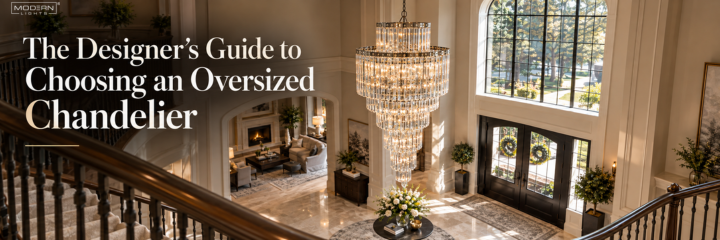
An oversized chandelier is one of the few pieces that can set the tone in a room before anyone even sits down. Get the scale wrong and it either gets lost in a high ceiling or overwhelms a modest one. Do it properly and it’s the thing people remember when they walk in.
This guide explains how to properly size one, what finish works for what kind of room and what really separates an oversized fixture from something that just photographs big.
A chandelier is oversized if it has 40 lights and is 60 inches or higher or wider in measurement. Oversized chandeliers are made for rooms with 10 foot ceilings and above. Size it with the room width + length rule, check ceiling clearance before placing the order, and select chrome for a modern room or gold for a traditional one depending on the metals already in the room.
What Makes a Chandelier Oversized
Oversized is more than a marketing word. Three things: light count, physical dimensions, and how the fixture is built to carry that scale.
Less than 20 lights, and 30 inches, it’s a standard chandelier for a normal ceiling. Once you get above 40 lights and into the 60 to 100 inch range, the fixture no longer reads as a light source but as architecture. A 38 light chandelier is already a statement piece at 72 inches wide. But a 66 light chandelier at 98.5 inches tall is meant for a whole different kind of space. A double height foyer where a standard fixture would look lost.
Frame construction is important here too. Laser cut steel or stainless steel frames keep their shape at scale, without sagging or flexing, which is why most oversized pieces use them instead of lighter wire construction. If a frame isn't able to support its own span, it won't stay level as time goes on.
The other marker is tiers. A 1 tier chandelier with 60 lights would be a wall of bulbs. Instead of the fixture’s scale being compromised by using the same lights on more levels, light can cascade down at varied heights rather than landing in a single, flat layer. That’s the difference between a chandelier that looks oversized in a good way and one that just looks like too much.
Sizing Your Space: Ceiling Height, Room Size, and Diameter
Sizing formula: Add your room's width and length in feet. That number becomes your chandelier's diameter in inches. A 20 by 24 foot great room calls for roughly a 44 inch diameter fixture.
It's a guideline, not a hard and fast rule, but it helps you avoid ordering something wildly out of scale.
Ceiling height changes the equation. In a normal room, you only have so much height to work with, and the bottom of the chandelier should be at least 7 feet off the floor. If you have a double height foyer or an open stairwell then you have a lot more vertical room to play with and that’s where a fixture like the 98.5 inch Brahms or the 86.5 inch Legrenzi comes into its own. Both are designed from the ground up for that scale — not adapted from a smaller design.
The Rondelle line is just the opposite: wide and relatively short, from 10 to 36 inches tall on frames from 72 to 84 inches wide. These are just right for rooms with regular or slightly high ceilings, over a dining table or in a foyer that doesn’t have the vertical drop for a tiered piece such as the Brahms.
Measure the actual ceiling height where you intend to hang the chandelier (not a guess) before ordering anything of this size. It's the difference between a fixture that anchors the room and one a guest has to duck under, by a few inches.
Chrome vs Two-Tone Gold: Picking a Finish for Formal Rooms
These two finishes are almost like different decades of design. Chrome (used in both the Rondelle and Brahms pieces) is laser cut steel or stainless steel and reads clean and architectural rather than stark. It photographs true to color under LED light, without the warm or cool shift that some plated finishes pick up.
Two-tone gold 24K, used on the Legrenzi, is a different construction, cast solid brass, not plated steel. That's why it ages the way it does, brass doesn't wear thin like plating, it develops a warm, consistent tone over years of use.
Which one works depends on what is in the room already. Chrome is naturally paired with brushed nickel hardware, glass and marble with cool undertones and generally reads more contemporary. Gold works with warm wood tones, brass fixtures used elsewhere in the house, and leans traditional or transitional. Putting a gold chandelier in an all-chrome room often feels like an afterthought instead of a deliberate choice, so it’s wise to walk through the space and note what metals are already in place in door hardware, faucets, and other lighting before making a decision.
Tiered Design: Why Layered Chandeliers Create Visual Drama
There’s a quick problem with a single-tier chandelier with a high number of lights: too many bulbs crammed into one flat ring just looks busy. That’s where tiering comes in. By stacking the lights at different heights, every fixture in this range, from the 38-light Rondelle to the 66-light Brahms, uses a tiered structure rather than a single ring.
The visual effect is a layered depth. You have light falling at several levels, instead of one wall of light, which looks more sophisticated and also spreads illumination more evenly throughout a tall space. In a double height foyer this also has practical implications: a single flat chandelier will illuminate the top of the room and leave the lower half dimly lit, while a tiered piece will cast light down through the entire height.
The number of tiers also affects how a chandelier reads from various angles. Because when you go up a staircase past a tiered chandelier, you will see a different silhouette at eye level than you see from the entry below. That's part of the reason these pieces work so well in stairwells specifically.
Six Oversized Chandeliers Worth Considering
These six do most of the work that oversized lighting needs to do, from anchoring a two story foyer to centering a large dining room. All are part of Kalco’s lighting collection, available from Modern Lights.

98.5" Brahms 66 Light Chrome Tiered Chandelier
$35,694.00 Shop Now
86.5" Legrenzi 48 Light Two Tone Gold 24K Chandelier
$32,210.00 Shop Now
36" Rondelle 57 Light Chrome Tiered Chandelier
$32,170.00 Shop Now
20" Rondelle 56 Light Chrome Tiered Chandelier
$27,496.00 Shop Now
10" Rondelle 44 Light Chrome Tiered Chandelier
$23,642.00 Shop Now
10" Rondelle 38 Light Chrome Tiered Chandelier
$20,096.00 Shop NowQuick reference on how the six compare:
| Model | Height | Width | Lights | Finish | Price |
|---|---|---|---|---|---|
| Brahms | 98.5" | 69.5" | 66 | Chrome | $35,694 |
| Legrenzi | 86.5" | 64.5" | 48 | Two-Tone Gold 24K | $32,210 |
| Rondelle 57L | 36" | 84" | 57 | Chrome | $32,170 |
| Rondelle 56L | 20" | 72" | 56 | Chrome | $27,496 |
| Rondelle 44L | 10" | 84" | 44 | Chrome | $23,642 |
| Rondelle 38L | 10" | 72" | 38 | Chrome | $20,096 |
Installation and Placement Tips for Statement Chandeliers
Fixtures of this size have adjustable chain or stem length, either 132 or 192 inches depending on the model, trimmed on site to fit your actual ceiling height. You don’t eyeball a job like that. Measure the finished hanging height first and have the installer cut to that length, instead of guessing and adjusting after.
All fixtures here are fully dimmable and rated for dry indoor use only and operate on standard 120V. The only thing they don’t include is the bulb: each of the six takes a Candelabra E12 base bulb rated up to 40W, sold separately, so you can choose your own brightness and color temperature.
Installation note: Given the light count on these pieces, from 38 to 66 sockets, and the weight of laser cut steel or cast brass at this size, this isn't a DIY install. Confirm your junction box is rated for the fixture's weight before ordering, and have a licensed electrician handle the mounting and wiring. See the Modern Lights Installation Guide before you book anyone.
If you are hanging something in a stairwell or a double height space, think about the cost of a lift or scaffolding to install it, as these are not fixtures you hang from a standard ladder.
Frequently Asked Questions
What is considered an oversized chandelier?
Generally a fixture with 40 or more lights and dimensions of 60 inches or larger in height or width. Below that, it reads as a standard statement chandelier rather than an oversized one.
How high should ceilings be for an oversized chandelier?
Tall pieces like a 98.5 or 86.5 inch tiered chandelier need a double height space, typically a two story foyer or open stairwell. Shorter, wider pieces in the 10 to 36 inch height range work in rooms with standard 9 to 12 foot ceilings.
What's the minimum clearance from the floor to the bottom of a chandelier?
Seven feet is the standard minimum in a room people walk through. In a foyer with a much taller ceiling, you have more flexibility, but always measure the specific space rather than relying on a general rule.
Chrome or gold, which finish is easier to maintain?
Both hold up well with normal dusting. Chrome resists fingerprints and shows dust less. Gold cast brass develops a warm patina over time rather than wearing unevenly, which some people prefer as it ages.
Can an oversized chandelier be installed on a dimmer switch?
Yes, all six of these are compatible with standard dimmer switches, which is worth doing given how much light a 40 plus socket fixture puts out at full brightness.
Do oversized chandeliers need a special electrical setup?
They run on standard 120V, so no special wiring is needed, but the junction box needs to be rated for the fixture's weight, and installation should go through a licensed electrician given the light count and size involved.
The trick to choosing an oversized chandelier is to match the actual size of the fixture to your space, not simply choosing whatever looks biggest in a photo. Measure first, then decide whether chrome or gold is best based on what’s already in the room. And have someone who knows how to deal with the weight and wiring safely do the installation.
Share:
Swing Arm Lights: A Guide to Adjustable Wall Lighting
Best Chandeliers for Dining Rooms This Fall: 7 Warm Picks for 2026