
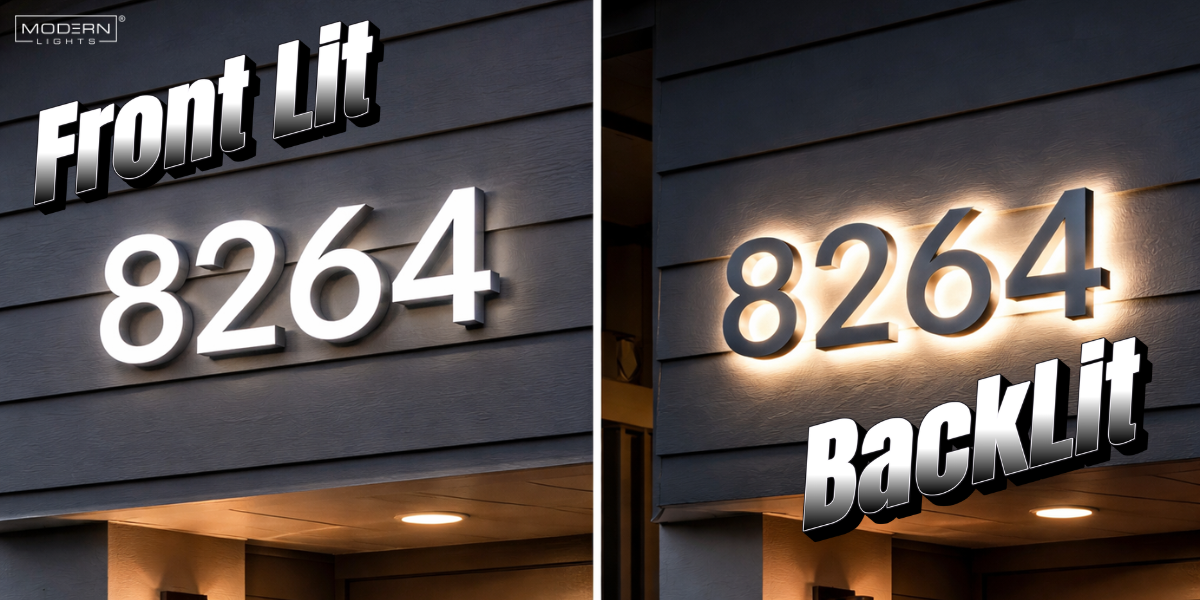
From basic metal digits, outdoor house numbers have developed into contemporary lighting accents that improve curb appeal and visibility. LED house numbers are particularly well-liked because they blend style and utility. They provide a home's façade a fashionable touch while making it simpler for guests, delivery drivers, and emergency personnel to locate a property at night.
Backlit and front-lit house numbers are two of the most popular types of lighting. Although each type makes use of LED technology, the brightness and visual effect are distinct. Homeowners can select the ideal alternative for their property's layout, lighting, and architectural style by knowing how these two solutions differ.
This tutorial outlines the benefits and cons of both front-lit and backlit house numbers, as well as how to choose the one that best suits your house.
What Are LED House Numbers?
LED house numbers are lit address numbers that can be installed outside. To make the numbers visible at night, they usually use low-energy LED illumination. These numbers are used by many contemporary homes to increase visibility and give the entrance a modern look.
LED house numbers produce their own illumination, in contrast to conventional metal numerals that depend on porch lights. This guarantees that the address is visible from the street regardless of the lighting in the area. The majority of types are appropriate for outdoor use because they are constructed from sturdy materials like aluminum, stainless steel, or weather-resistant acrylic.
LED house numbers are frequently chosen by homeowners for both aesthetic and visibility reasons. Lighting features that draw attention to entrances, walkways, and house numbers are a common feature of contemporary exterior architecture. In addition to completing that style, illuminated numbers offer useful advantages for safety and navigation.
What Are Backlit House Numbers?
LED lighting is positioned behind the number structure in backlit house numbers. The light extends outward from behind the number and reflects onto the wall surface rather than shining straight at the observer. As a result, each digit's shape is outlined by a halo-like radiance.
This type of lighting creates a delicate and sophisticated appearance that complements modern and minimalist interior design. Without coming across as unduly bright or harsh, the halo effect provides depth and visual appeal.
Spacers are typically used to hang backlit house numbers somewhat away from the wall. This makes it possible for light to disperse uniformly around the numerals, giving them the distinctive floating effect. The final appearance may differ slightly based on the color and texture of the wall because light bounces off its surface.
Backlit numbers are frequently regarded as the most aesthetically pleasing choice for homeowners looking for discreet lighting with a modern feel.
How Backlit Address Numbers Work
LED modules are positioned behind each digit to create backlit house numbers. When the lights come on, the light reflects from the wall and spreads around the edges of the numbers. The contour of the numbers is highlighted by a gentle halo created by this reflection.
The numerals are held slightly away from the wall in the majority of designs by tiny mounting spacers. This opening makes it possible for the light to spread uniformly and keeps the surface from obstructing the glow. A floating effect that improves the contemporary appearance is the end product.
Backlit numbers provide a subtle, beautiful appearance because the illumination flows outward instead of forward. The glow maintains a balanced brightness level that blends in seamlessly with outdoor illumination while yet being visible from the street.

Advantages of Backlit House Numbers
The popularity of backlit house numbers can be attributed to their elegant design and practicality. The halo lighting effect creates a sleek, contemporary look that goes well with modern architecture.
The gentle glow they create is one benefit. The radiance disperses uniformly around the numerals rather than glaring straight at the viewer. This eliminates glare and produces a distinct visual contour that is simple to identify from a distance.
Their aesthetic value is an additional advantage. Rather than being merely a functional component, backlit numbers frequently become a design element. They add to a home's overall curb appeal and assist create a polished external appearance when placed next to an entrance or gate.
They are perfect for homes that prefer soft lighting over bright lighting because of their balanced lighting.
Disadvantages of Backlit House Numbers
Even though backlit house numbers have a contemporary appearance, there are a few things homeowners should think about before selecting this design.
One drawback is that the surface behind the numerals affects the brightness to some extent.
Darker surfaces may lessen the halo effect's strength since the glow reflects off the wall. The most noticeable illumination is typically produced by light-colored walls.
Installation is another factor to take into account. To get the ideal lighting appearance, backlit numbers must be carefully spaced and aligned. The halo glow may be diminished or the numbers may appear uneven due to improper mounting.
Lastly, backlit numerals might not seem as bright from a distance as frontlit models due to the indirect light. Stronger forward lighting may be beneficial for homes with large front yards or long driveways.
What Are Front Lit House Numbers?
LED lighting is used in front-lit house numbers, shining directly through the digits' front surfaces. The full face of each digit illuminates, making the numbers extremely apparent from the street rather than forming a halo around them.
The goal of this lighting design is to optimize readability and brightness. Even at a considerable distance, the numbers look bold and distinct when viewed at night.
Homes with big front yards, long driveways, or little outside lighting are frequently assigned front-lit house numbers. Even in darkened environments, it is still simple to recognize the numbers since the light is projected outward.
Even while front-lit numbers have a more straightforward appearance than backlit ones, they still complement contemporary home exteriors. They are very useful for enhancing address visibility and making sure guests can find the house promptly because of their powerful illumination.
How Front Lit LED Numbers Work
LED lighting is used into each digit's structure in front-lit house numerals. The front surface, which is usually composed of acrylic or another translucent material, allows light to pass through.
The full face of the number lights brightly when lighted. The numbers are easier to read from a distance because of the direct illumination, which makes them stand out against the background.
Internal diffusers that distribute the light uniformly across the surface are a common feature of front-lit designs. This guarantees that the full number appears uniformly lighted and avoids bright spots.
Front-lighted numerals provide excellent visibility because the light is directed outward, which is useful in dimly lit areas or places where the home is far from the road.

Advantages of Front Lit House Numbers
One of the main benefits of front-lit house numbers is their outstanding visibility. Visitors can instantly identify the address thanks to the direct illumination, which makes each numeral brilliant and readable even from a distance.
Homes with long driveways or those situated in places with little street lighting look particularly good with this design. Regardless of the surroundings, the numbers will always be visible because to the striking lighting.
Their clarity is an additional advantage. The digits appear clear and distinct because light is shining directly through the number surface. For emergency services and delivery trucks that depend on legible address markers, this enhances readability.
Additionally, adaptable, front-lit numbers don't require wall reflection and can be placed on a range of surfaces.
Disadvantages of Front Lit House Numbers
Although they offer powerful illumination, front-lit house numbers might not be to everyone's taste. The brightness is more obvious to some homeowners than the softer glow that backlit models produce.
The effect may seem more practical than ornamental since the light is shining straight forward. Sometimes the more subdued halo effect is more advantageous for homes with minimalist architecture.
Light intensity is another thing to think about. Front-lit numbers may appear excessively bright in comparison to adjacent fixtures in regions with strong outside illumination.
Backlit designs may feel more aesthetically matched with other external lighting components for homeowners that value a softer, more ornamental lighting style.
Backlit vs Front Lit House Numbers:
Understanding the difference between backlit and front lit house numbers becomes easier when comparing their lighting style, brightness, and installation. The table below highlights the key distinctions between the two options.
Backlit vs Front Lit House Numbers: Side-by-Side Comparison
|
Features |
Backlit House Numbers |
Front Lit House Numbers |
|
Lighting style |
Light shines from behind the numbers, creating a halo glow around the digits. |
Light shines directly through the front face of the numbers toward the viewer. |
|
Visual appearance |
Soft, elegant illumination that blends with modern architecture. |
Bright and bold lighting that makes the numbers highly noticeable. |
|
Brightness level |
Moderate brightness with a subtle glow effect. |
Strong brightness designed for maximum visibility. |
|
Visibility distance |
Best for homes closer to the street or with good exterior lighting. |
Ideal for homes with long driveways or properties far from the road. |
|
Design style |
Popular for modern, minimalist, and contemporary home exteriors. |
Works well for both residential and commercial properties where clarity is important. |
|
Glare |
Low glare because the light reflects off the wall surface. |
Slightly brighter appearance since the light faces outward. |
|
Installation style |
Requires spacers to create a gap between the number and the wall for the halo effect. |
Mounted directly to the surface with lighting inside the digits. |
|
Best use case |
Decorative curb appeal with subtle lighting. |
Maximum address visibility for visitors and deliveries. |
Which Type of House Numbers Is Better for Your Home?
There are a few things to think about while deciding between backlight and front-lit house numbers, such as the layout of the property and the illumination in the area. The distance between the house and the street is an important thing to think about.
Front-lit numbers might be better for homes that are farther back because the greater light makes them easier to see from a distance. Backlit numerals may be clear enough for properties that are closer to the road and add a nice halo effect.
The style of the building also matters. Backlit numerals look great on modern homes with clean lines because the illumination makes the minimalist design stand out. In older homes or on bigger properties, bright lights may be more important than decorative ones.
Homeowners may pick the best solution by looking at things like visibility, design preferences, and where they want to install it.
When to Choose Backlit House Numbers?
For homeowners who like modern style and soft lighting, backlit house numbers are a great choice. The halo glow behind the numbers makes them look like they're floating, which goes well with modern architecture and simple exteriors.
They perform well on entry walls, gates, or feature panels where the light can make the area around them look better. Walls that are light in hue typically make the halo effect stronger and the glow more visible.
Backlit numbers are also great for homes where the outside illumination is already bright enough to see well. They don't make the entryway brighter; instead, they offer a decorative lighting element that makes the whole entrance look better. For homeowners focused on aesthetics and curb appeal, backlit numbers often deliver the most visually appealing result.
When to Choose Front Lit House Numbers?
Front-lit house numbers are great for times when being able to see them is the most important thing. Homes that are far from the street or have long driveways often need brighter lights so that people can readily find the address.
This form also works well in areas with little street lighting. The bright forward light makes sure that the numbers can be seen even when it's dark.
Front-lit numbers are useful for big properties, businesses, or residences when the address needs to be seen from a long way away.
The numbers shine directly toward the viewer, making them look clear and bright. This makes it easier for guests, delivery services, and emergency responders to find their way around.
Key Factors to Consider When Buying Lighted House Numbers
When choosing lighted house numbers, there are a number of things that can affect how they look and how well they work. Size is one of the most crucial things to think about. It's usually simpler to view larger numbers from the street, especially if they're mounted farther away from the curb.
The quality of the material is also very important. Stainless steel and aluminum are two examples of durable materials that won't rust or get damaged by the elements. This means that the numbers will look the same throughout time.
The power supply also affects how easy it is to install and use. Some LED numbers link to low-voltage cable, while others get their electricity from the sun or by being plugged in.
Taking these things into account can help homeowners pick house numbers that not only look good but also give off reliable light.
FAQ'S
Are LED house numbers bright enough to see from the street?
Yes, most LED house numbers are made to be easier to see from the street at night. The distance between the house and the road, the size of the numbers, and the kind of lighting all affect how bright it appears. Numbers that are lit from the front usually have greater light since the light shines straight at the viewer. Backlit numerals give off a softer glow, yet the halo effect makes the numbers easy to see even when it's dark. Choosing bigger numbers and putting them in a good spot can make them even easier to read, making it easier for guests and delivery drivers to find the address quickly.
Are illuminated house numbers weather resistant?
Most high-quality LED house numbers are made to last outside. To preserve the internal lighting parts, manufacturers usually employ materials like stainless steel, powder-coated aluminum, and acrylic that can stand up to the elements. These materials help keep out rain, snow, humidity, and variations in temperature all year long. A lot of LED address numbers are additionally sealed so that moisture can't get into the electrical parts. If they are put in the right way, they can work for many years without breaking. If you want your lighting system to work well in all kinds of weather, you should use supplies that are made for outdoor use.
What size house numbers are easiest to read from a distance?
It depends on how distant the house is from the street what size is best. Most residential areas have house numbers that are between 5 and 8 inches tall, which is usually enough for people to see. Ten- or twelve-inch numbers may be better for homes with longer driveways or those that are farther back from the road. Emergency responders and delivery personnel can see addresses better when the numbers are bigger and simpler to see from a distance. When choosing lit numerals, size is quite crucial. Bigger numbers let more light spread out evenly, which makes the address easier to see at night.
Do LED house numbers require a lot of electricity?
LED technology is noted for using less energy, which makes it cheap to run lit house numbers. LED modules use very little power compared to regular lights, but they nevertheless provide strong, steady light. Many systems use low-voltage wiring, which cuts down on electricity use even more. LED lights are made to last for thousands of hours, so they don't need to be replaced very often. Some people also prefer solar-powered house numbers, which get their power from sunlight during the day. LED house numbers are a good choice for outdoor illumination because they require less energy and last a long time.
Where should illuminated house numbers be installed?
Putting the address in the right spot makes sure that it can be seen from the street. Most of the time, house numbers are put up next to the front door, on the wall next to the front door, or above the garage. Some homeowners put them on mailbox posts, fence posts, or gate pillars when the house is farther back from the road. Choosing a spot that faces the street without being blocked by trees or buildings is the most important thing. Putting the numerals at eye level and making sure they stand out from the wall can make them much easier to see, especially at night.
Conclusion
Illuminated house numbers are a useful method to make both curb appeal and visibility better. They use current design and LED lighting technologies to make sure that a location is still easy to find after dark. Well-lit house numbers are good for homeowners because they help visitors find their way, delivery drivers find their way, and emergency responders find a property quickly.
There are pros and cons to both backlit and front illuminated house numerals. Backlit designs make a gentle halo effect that goes well with modern architecture and makes outdoor spaces look more elegant. Front-lit numbers are brighter, so they can be seen from farther away. They are wonderful for properties with long drives or dark areas.
The layout of the house, the amount of light, and your own design tastes all play a role in choosing the proper style. Homeowners can choose illuminated house numbers that improve both the function and the look of their property by thinking about how visible they are, where they should go, and how big they should be.
Share:
How Address Plaques Increase Property Value and Curb Appeal?
9 Creative Ways to Display Your House Numbers