
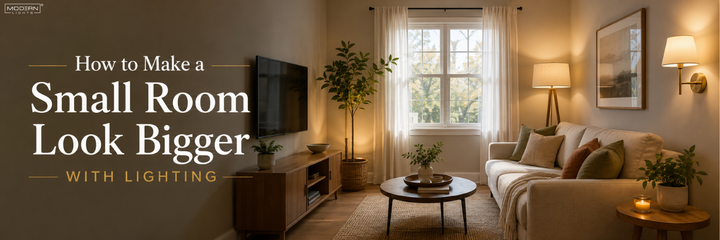
A small room can feel surprisingly spacious with the right lighting. You don’t need to change the floor plan or fill the room with mirrors to achieve this effect. Sometimes, simply redistributing light can make the space feel brighter, more open, and more comfortable.
The best way to make a small room look bigger with lighting is to use multiple light sources, brighten dark corners and walls, and choose fixtures proportional to the room. Flush-mount lights, wall sconces, recessed lighting, and slim pendants can all work well if used in the right places.
The trick is to think beyond the one ceiling light. Different layers of lighting can add depth, highlight vertical surfaces, and make the entire room feel more balanced.
Why Lighting Can Make a Small Room Feel Bigger
Lighting changes the way we perceive the size and shape of a room.
In a small room with one bright fixture in the middle and dark corners around it, the edges of the space are more visible. This can make the room feel closed in, even if there's enough light to see everything. You spread the light about the room, and you produce the opposite effect. Walls, corners, and other vertical surfaces can be illuminated to allow the eye to take in more of the space.
Light direction makes a difference too. Light shining on a wall can increase the brightness of the surface and push it visually away. Lighting that is directed upwards can help to draw attention to the ceiling, something that can be especially useful in rooms with low ceilings.
This is why good small-room lighting isn't necessarily about using brighter bulbs. It's about placing light strategically.
Use Layered Lighting
Layered lighting is one of the most effective ways to make a small room feel larger. Instead of using one fixture, use a variety of lighting to create several points of light at different heights.
Start With Ambient Lighting
Ambient light generally lights the room. Choose a flush-mount ceiling light, semi-flush-mount fixture, or recessed lighting for general coverage without taking up too much visual space.
For a room with a low ceiling, a flush-mount light is often a particularly practical choice because it sits close to the ceiling.
Add Task Lighting
Task lighting provides focused illumination where you actually need it. A table lamp next to a sofa, a desk lamp in a home office,e or a reading light next to a bed can provide the helpful light without requiring another big overhead fixture.
Task lights are generally smaller, so they can add another level of light without making a small room feel cluttered.
Finish With Accent Lighting
Accent lighting adds depth and draws attention to specific features. Wall sconces, picture lights, cabinet lighting, ng and small directional fixtures are also fabulous ways to highlight artwork, shelving, architectural details, or a feature wall.
You don't need a fixture in every corner. The goal is to create a balanced combination of light sources rather than one overly bright area.
Brighten Walls and Dark Corners
One of the simplest ways to make a small room look bigger is to stop the corners from disappearing into darkness. Dark corners also help to create visual boundaries, so the room feels more enclosed. Light in those areas makes it possible to see the full dimensions of the space.
Wall sconces are particularly helpful for this because they give off light without using floor or table space. Depending on the design, a sconce may project light upward, downward, or across the wall. Upward-facing wall sconces can make the ceiling appear taller by drawing the eye upward. Light fixtures that spread light on the wall can make a vertical surface look brighter and larger.
Recessed lighting can also be pointed to walls or certain parts of the room. If you are considering recessed lights, don’t put each one right in the middle of the floor. You can have better overall coverage with a more thoughtful layout.
Table lamps and floor lamps can also help to deal with dark corners, especially in living rooms and bedrooms.
Sconces That Free Up Floor Space
5'' Amberle Matte Black 1 Light Wall Sconce
Compact 5 inch profile for narrow walls, hallways and tight bedside gaps.
$49.90

4.38'' Durham Satin Nickel 1 Light Wall Sconce
Shallow projection that washes the wall instead of crowding the walkway.
$73.90
Choose the Right Fixtures for Small Spaces
The size of your lighting fixtures can have a major impact on how spacious the room feels. A fitting that looks perfect in a large room can overpower a smaller one. Lighting should be selected according to room size, ceiling height, furniture, and available walking space.
Flush-Mount Lights
Flush-mount fixtures are a good choice for many small rooms, especially those with low ceilings. They provide overhead light and keep the fixture close to the ceiling. They’re a practical option for bedrooms, hallways, small living rooms, and other places where a hanging fixture might be too visually bulky.
Low-Profile Ceiling Fixtures

Semi-Flush-Mount Lights
Semi-flush mounts provide slightly more dimension than flush mounts while still maintaining a relatively compact profile. They're useful when you want a decorative ceiling fixture without committing to a large chandelier or pendant.


Mini Pendant Lights
A small room doesn’t mean you have to avoid pendant lighting. The scale of the space is key when selecting a fixture. A mini pendant is particularly effective over a small dining table, kitchen island, or reading nook. Just be sure to leave enough space around the fixture and that it does not visually dominate the room.


Wall Sconces
Wall sconces are among the most space-saving lighting options out there. They are fixed on the wall to give functional or decorative light without taking up valuable floor or table space. They can be a good alternative to bigger lamps or fixtures in small bedrooms, living rooms, hallways, and bathrooms.


Use Mirrors and Natural Light
Artificial lighting is only part of the equation. Natural light can make a small room feel considerably more open during the day. Begin by keeping your windows as clean as possible. Thick curtains, large furniture, or decorative items placed in front of a window can affect how far light travels into the room. Mirrors can help reflect that natural light. A mirror across from or beside a window can reflect daylight around the room and make the room seem brighter. You can also reflect artificial light with mirrors. Place one near a wall sconce, pendant, or lamp to broaden the amount of light that appears to permeate the room.
Light-colored walls and moderately reflective surfaces can also help to reinforce the effect. You don't need to make every surface glossy. Lighter finishes, combined with the right lighting, can also help combat the feeling of visual heaviness.


Choose the Right Light Color and Brightness
The color temperature of your light bulbs affects how the room looks and feels.
Between 2700K and 3000K is generally a warm and comfortable look for bedrooms, living rooms, and other relaxing areas. This range works well when you want the room to feel inviting rather than overly bright.
For kitchens, home offices, and other task-oriented spaces, 3000K to 4000K can provide a cleaner and brighter appearance.
You want to check the brightness and also the color temperature. A tiny room doesn’t necessarily require super bright lighting. Too much brightness can cause glare and make the space uncomfortable.
Instead, use a few light sources of the appropriate size and vary their brightness to suit. Dimmers can be especially helpful because you can use brighter light when working or cleaning and softer light when relaxing.
Try to keep the color temperature reasonably consistent within the same room. Mixing very warm and very cool bulbs can make the lighting feel disconnected.
Best Lighting for Different Small Rooms
Different rooms have different lighting requirements, so the best approach depends on how the space is used.
Small Living Room
A small living room can be improved by a combination of a flush or semi-flush ceiling light, a floor or table lamp, and wall lighting. Don’t place all the light overhead. Use lamps and sconces to bring light down near walls and seating areas. This creates a cozier and more layered atmosphere.
Small Bedroom
In a small bedroom, start with small-scale ambient lighting such as a flush-mount fixture. Then think about wall sconces next to the bed instead of bulky bedside lamps. This frees up space on nightstands while providing focused reading light.
Small Dining Room
A pendant or small chandelier can work well over a dining table, even in a compact dining area. Select a fixture that is appropriate for the size of the table and room. A too-large fixture can easily become the main visual element.
Small Home Office
A home office needs a balance between general and task lighting. Select general ceiling lighting for the room and add a desk lamp for task work. Position the lights carefully to minimize shadows and glare from the screen.
Small Hallway
Ceiling fixtures are especially useful in hallways because of the limited floor and wall space. Flush-mounted, recessed, or compact wall sconces can provide light without constricting the visual space.
Common Lighting Mistakes That Make Rooms Feel Smaller
Even the right lighting fixtures can make a room feel cramped when they're poorly selected or positioned.
Relying on One Central Light
One ceiling fixture may illuminate the center of the room while leaving the edges dark. Adding smaller light sources can provide much better distribution.
Leaving Corners Dark
Dark corners make the boundaries of a small room more noticeable. Use a lamp, wall sconce, or accent light to bring some illumination into those areas.
Choosing Oversized Fixtures
Large chandeliers and pendants can overwhelm compact rooms. Always consider the fixture's proportions in relation to the room and furniture.
Ignoring Ceiling Height
Long-hanging fixtures can make a low ceiling feel even lower. Flush and semi-flush fixtures are often better choices when vertical space is limited.
Mixing Too Many Color Temperatures
Using warm and cool bulbs randomly throughout one room can create an inconsistent appearance. Choose a color temperature that suits the room and use it consistently.
Making Everything Equally Bright
A room doesn't need to be illuminated at the same level from floor to ceiling. Some variation in brightness creates depth and makes the lighting feel more natural.
Final Tips for Making a Small Room Look Bigger
In fact, lighting a small room to make it feel larger is more than simply putting in the biggest or brightest fixtures you can find. It's about the purposeful use of light. Start with ambient lighting that suits the size of the room and the height of the ceiling. Then look for the areas that still feel dark and add task or accent lighting where it makes sense. Use wall sconces to illuminate vertical surfaces, lamps to bring light to darker areas, and ceiling fixtures of appropriate size for general illumination. If you have low ceilings, opt for small fixtures close to the ceiling.
Take advantage of natural light during the day and use mirrors to bounce it around. Layered artificial lighting in the evening can give the same sense of openness with more control over the atmosphere. Most importantly, choose lighting according to the room’s proportions, layout, furniture, and purpose, not just because it’s a lighting trend.
A small room can feel bright and spacious when every light source has a purpose.
Shop Small-Space Lighting at Modern Lights
Every fixture in this guide is available at Modern Lights, sized and filtered so you can shop by the dimensions that actually matter in a compact room. Start with the flush mount collection for low ceilings, then layer in wall sconces to light the walls and free up your nightstands and side tables.
Orders over $99 ship free, discounts run across the collections, and our support team is available whenever you need help matching a fixture to your room size. Browse more guides on the Modern Lights blog or contact us and we will help you plan the layers.
FAQs
What lighting makes a small room look bigger?
Layered lighting is one of the best ways to make a small room look bigger. Combine ambient ceiling lighting with wall sconces, lamps, or accent lighting to spread illumination throughout the space and reduce dark corners.
Do wall sconces make rooms look bigger?
Yes, wall sconces can make a small room feel more spacious. They illuminate walls and reduce dark areas while taking up very little floor or table space. Upward-facing sconces can also draw attention toward the ceiling.
Are flush-mount lights good for small rooms?
Yes. Flush-mount lights are an excellent choice for many small rooms, particularly those with low ceilings. They provide general illumination while sitting close to the ceiling and taking up minimal visual space.
What color temperature is best for small spaces?
2700K to 3000K is generally a good choice for bedrooms and living spaces, where warm and comfortable lighting is preferred. For kitchens, offices, and other functional areas, 3000K to 4000K can provide a brighter, cleaner appearance.
Should a small room have one large light or several smaller lights?
Several appropriately sized light sources are usually better than one large fixture. Layered lighting allows you to illuminate different areas of the room and reduces the dark corners that can make a small space feel enclosed.
Does lighting make a small room look bigger?
Yes. Strategic lighting can make a small room appear brighter, more open, and deeper. Illuminating walls, corners, and vertical surfaces while choosing fixtures that fit the room's scale can have a noticeable visual effect.
Share:
How to Replace a Ceiling Fan Light Kit?
What Are Wall Sconces Used For?