
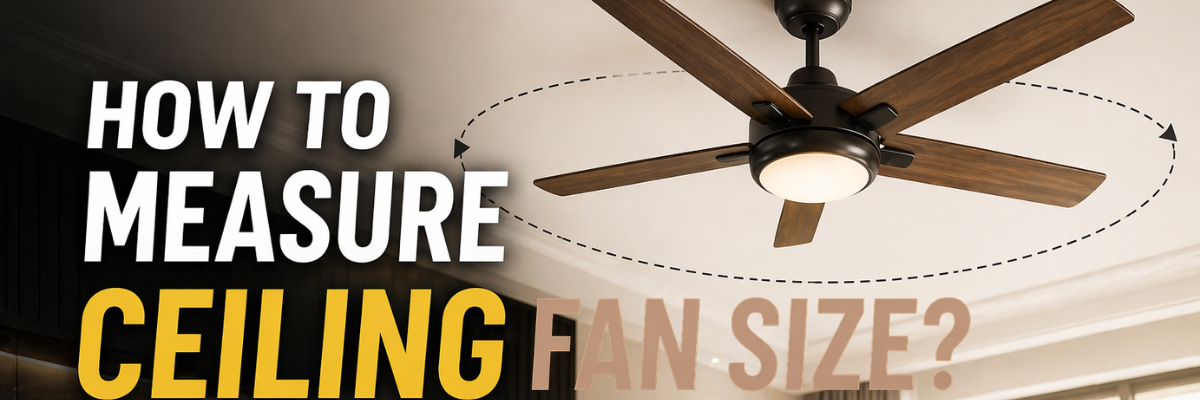
Choosing the right size for its ceiling fan is about more than what looks good above your head. It influences how the fan performs, how comfortable the space feels, and whether the fan looks appropriately scaled when installed.
A fan that’s too small lets you feel stifled in a room. And a fan that is too big can visually overpower the space and, in some cases, create more flow than you really want (if any) in a small room. That is the reason why correct ceiling fan size measurement is more than taking measures of the blades. You also want to know the size of the room and ceiling height you’ll be dealing with, as well as what kind of mounting the fan will have.
This guide walks you through how to measure, choose, and optimize ceiling fan size for better airflow efficiency and room comfort.
Quick Answer: What Ceiling Fan Size Do You Need?
Ceiling fan size is typically measured by blade span, the full diameter of the fan from the tip of one blade to the opposite tip of the blade. To select the proper size, start by measuring your room’s square footage, and then find a recommended fan span to suit those dimensions. Sizing guides generally suggest smaller fans for tight rooms, mid-size ones for bedrooms and standard living spaces, and larger fans for open-concept rooms and great rooms.
Ceiling Fan Size Chart by Room Size
|
Room Size |
Recommended Fan Size |
|---|---|
|
Up to 75 sq. ft. |
29 to 36 inches |
|
76 to 144 sq. ft. |
36 to 42 inches |
|
145 to 225 sq. ft. |
44 to 50 inches |
|
226 to 400 sq. ft. |
50 to 54 inches |
|
Over 400 sq. ft. |
60 inches or larger, or multiple fans |
This general size range aligns with the patterns used by major ceiling fan buying guides, even if exact cutoffs vary slightly by retailer.
How Ceiling Fan Size Is Measured?
When a ceiling fan is described as 42 inches, 52 inches, or 60 inches, that number usually refers to the blade span, not the motor housing or total fixture width. Blade span means the full diameter of the fan from one end of the blades to the other. This is the main measurement used to compare fan sizes because it gives the clearest picture of how much area the fan will cover once installed.
How to measure a fan with an even number of blades
If the fan has an even number of blades, measure directly from the tip of one blade to the tip of the blade directly across from it. That gives you the full diameter.
How to measure a fan with an odd number of blades
If the fan has an odd number of blades, measure from the center of the fan to the tip of one blade, then double that number. That gives you the full blade span. This is the standard workaround because there is no blade directly opposite the one you are measuring.
How to Measure Your Room for a Ceiling Fan?

Measure the room — not the furniture in it — before selecting a fan. Measure the length and width of the room in feet. Next, you multiply those numbers to arrive at the square footage. A 12-foot-by-14-foot room, for example, is 168 square feet. That puts it in the zone where a fan between around 44 inches and 50 inches often works. This is an important step because ceiling fan size should be determined by the room the fan is to serve, not just what size feels familiar.
What Does a 52-Inch Ceiling Fan Mean?
A 52-inch ceiling fan indicates a blade span of approximately 52 inches between one blade tip and the other.
This size of fan is one of the most widely used as it will perfectly suit many medium to large rooms. It is common in bedrooms, living rooms, dining rooms and other everyday spaces where the room is small but not oversized. That’s why 52-inch fans are so ubiquitous in retailer collections and buying guides. It offers a balanced combination of airflow, efficiency, and visual proportion, making it a popular choice in most homes.
How Ceiling Height Affects Fan Size and Mounting?

Ceiling fan size is only part of the equation. Ceiling height changes how the fan should be mounted, and that affects both airflow and visual proportion.
Most experts recommend keeping fan blades at least 7 feet above the floor for safety. For best airflow, many guides recommend mounting the blades 8 to 9 feet above the floor when possible. Proper mounting ensures better air circulation and energy efficiency.
Low ceilings
If the ceiling is low, a flush-mount or low-profile ceiling fan is usually the better choice. This keeps the fan close to the ceiling while maintaining proper clearance.
Standard ceilings
For standard ceiling heights, a typical mount often works well without needing special adjustment. In these rooms, choosing the right blade span usually matters more than changing the mount type.
High or vaulted ceilings
For taller or vaulted ceilings, a downrod is often necessary. Without it, the fan may sit too high to move air effectively where people actually are.
How to Measure Ceiling Fan Downrod Length?

Downrod length is not just about fit. It is about getting the fan to the right operating height. A room with a very high ceiling may need a longer downrod so the blades sit low enough to circulate air effectively. A fan mounted too high can look fine on paper, but still feel weak in daily use. A simple way to think about it is this: the taller the ceiling, the more important hang height becomes.
What If the Room Is Open-Concept or Irregularly Shaped?
This is one of those spots where a lot of simple ceiling fan size charts fall short. If you have an open-concept space, a long great room, or a combined living and dining area, likely, the room doesn’t act like a simple rectangle. In those situations, a single oversized fan might work, but in other cases, it makes more sense to use two properly spaced fans rather than one central unit. Not every room is a clean rectangle, and wide-ranging sizing tips often have to be customized based on the configuration.
For those irregularly shaped rooms, this strategy helps you visualize in terms of the literal area where airflow is needed most (rather than just the total floor plan).
Common Ceiling Fan Sizing Mistakes
One of the biggest mistakes is deciding on a fan based purely on looks. A fan can look sharp in the room, but if the blade span is too small, it may leave you wanting more of a breeze.
Another frequent faux pas is overlooking ceiling height. A properly sized fan that is positioned too high up can still not effectively circulate air where it counts.
A third error is to assume one size fits all. A 52-inch fan is popular for a reason, but it’s not necessarily the right solution for every bedroom, living room, patio, or large open space.
Best Ceiling Fan Types by Room
Bedroom ceiling fans
Bedrooms usually do best with a fan that feels scaled correctly, runs quietly, and provides comfortable airflow without overpowering the room.
Living room ceiling fans
Living rooms often need a slightly larger fan because they tend to be more open and more heavily used.
Great room and large ceiling fans
Large rooms need broader airflow coverage, which often means a larger blade span or sometimes multiple fans, depending on the layout.
Outdoor ceiling fans
Outdoor or covered patio fans still need to be sized properly, but they also need the correct damp rating for the environment.
Low-profile ceiling fans
Rooms with lower ceilings often benefit from low-profile fans because they solve the clearance problem without forcing the homeowner to choose a fan that is too small.
Shop Ceiling Fans
FAQ's
How do you measure ceiling fan size?
You measure it by blade span—the full diameter from one blade tip to the opposite tip.
What does a 52-inch ceiling fan mean?
It means the fan has a blade span of about 52 inches. That is the diameter of the fan from one blade tip to the opposite side.
What size ceiling fan do I need for a 12x12 room?
A 12x12 room (144 sq. ft.) typically requires a 36–42 inch fan, depending on layout and ceiling height.
Can a ceiling fan be too big for a room?
Yes. A fan can be too large visually or functionally if it overwhelms the room or creates more airflow than is comfortable for the space.
Does ceiling height affect fan size?
It affects mounting and airflow performance more than blade span directly.
Conclusion
Measuring ceiling fan size correctly means more than measuring the blades. You also need to measure the room, understand the ceiling height, and think about how the fan will actually perform once installed. The best fan size is the one that feels balanced in the room, moves enough air for the space, and is mounted at the right height to do its job well. That is what turns ceiling fan sizing from a guess into a smart decision.
Share:
Ceiling Fan Direction for Summer and Winter: Which Way Should It Spin?
Table Lamps — Small Detail That Changes Everything